best website for real estate leads
Your Real Estate Website Is Not Getting Leads? Here's Exactly What to Fix (2026)
Real estate website getting traffic but no leads? Here are the 7 specific fixes that turn a passive site into an active lead generation tool for agents.
Traffic without enquiries is a conversion problem, not a marketing problem. Here are the seven specific fixes that turn a passive real estate site into an active lead source.
By Sheikh Hassaan — Website developer for service businesses
Quick Answer
A real estate website that gets traffic but no leads is almost always failing at one or more of seven specific points: no clear call to action above the fold, slow load speed, missing trust signals, a broken mobile experience, generic copy that does not differentiate, a contact form with too much friction, or no local SEO signals in the site structure. Each of these is fixable without rebuilding the entire site.
Why a Real Estate Website Can Look Good and Still Generate Nothing
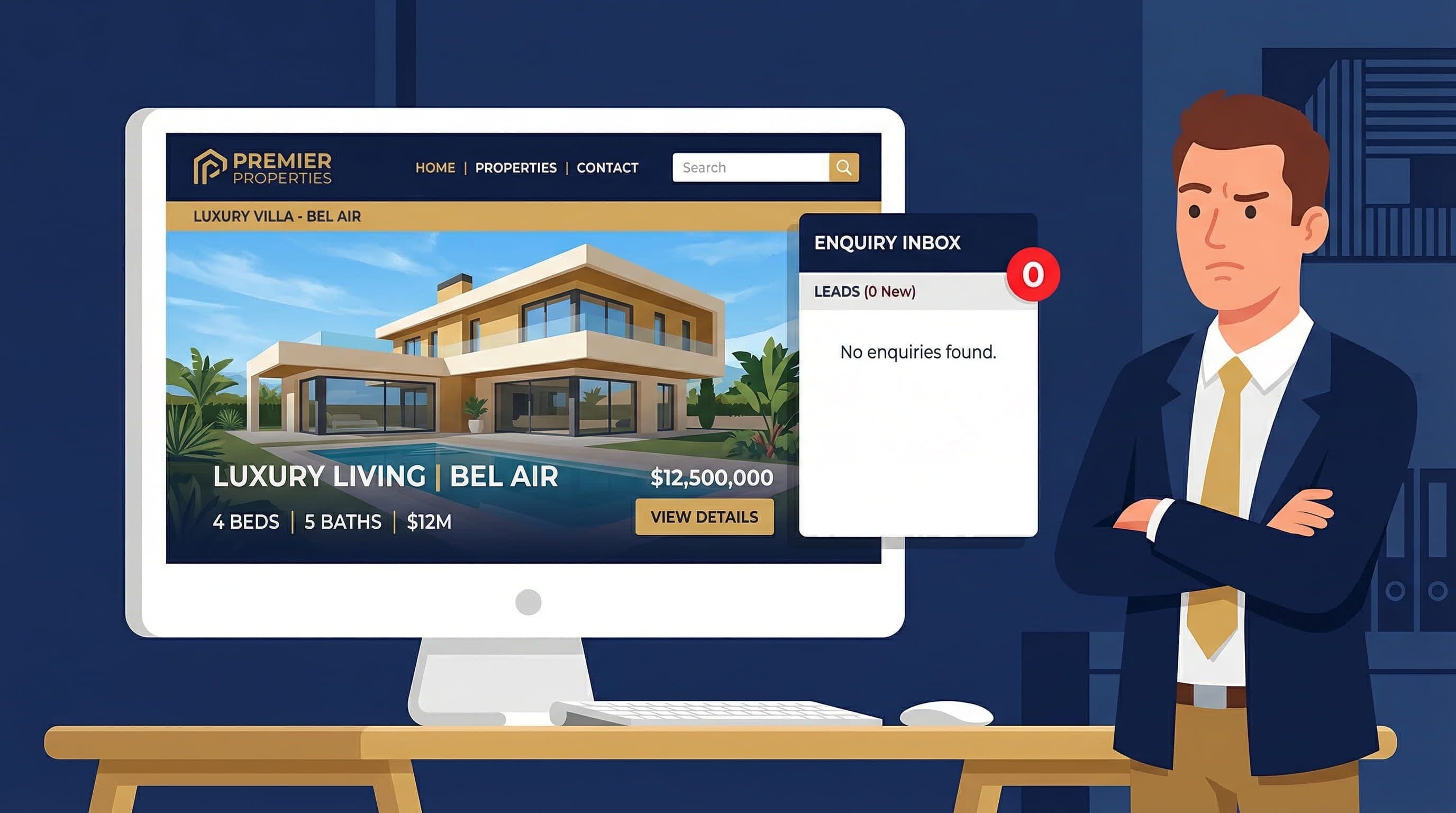
The most common misconception about real estate websites is that design equals performance. An agent pays for a site that looks clean, professional, and credible. It loads. It works. The property photos are high quality. And it generates nothing.
This happens because design and conversion are different disciplines. A site can be visually impressive while failing at every functional element that turns a visitor into an enquiry. No clear next step. Copy that describes the agent without addressing the client. A contact form buried three scrolls below the fold on a page most visitors never reach. A mobile experience that looks functional on a desktop preview but breaks on the phone that 60 to 70 percent of visitors are actually using.
For a luxury real estate agent, the cost of a non-converting site is particularly high. The average transaction value in the luxury market means that a single missed lead can represent tens of thousands in lost commission. A site that has been live for 12 months without generating a qualified enquiry has not been a free asset. It has been an expensive liability dressed up as a marketing investment.
The good news is that most of these problems are not design problems. They are configuration and copy problems. They do not require rebuilding the site. They require identifying which specific element is failing and fixing it with precision.
The Lead Generation Diagnosis Table
Real estate website lead generation audit
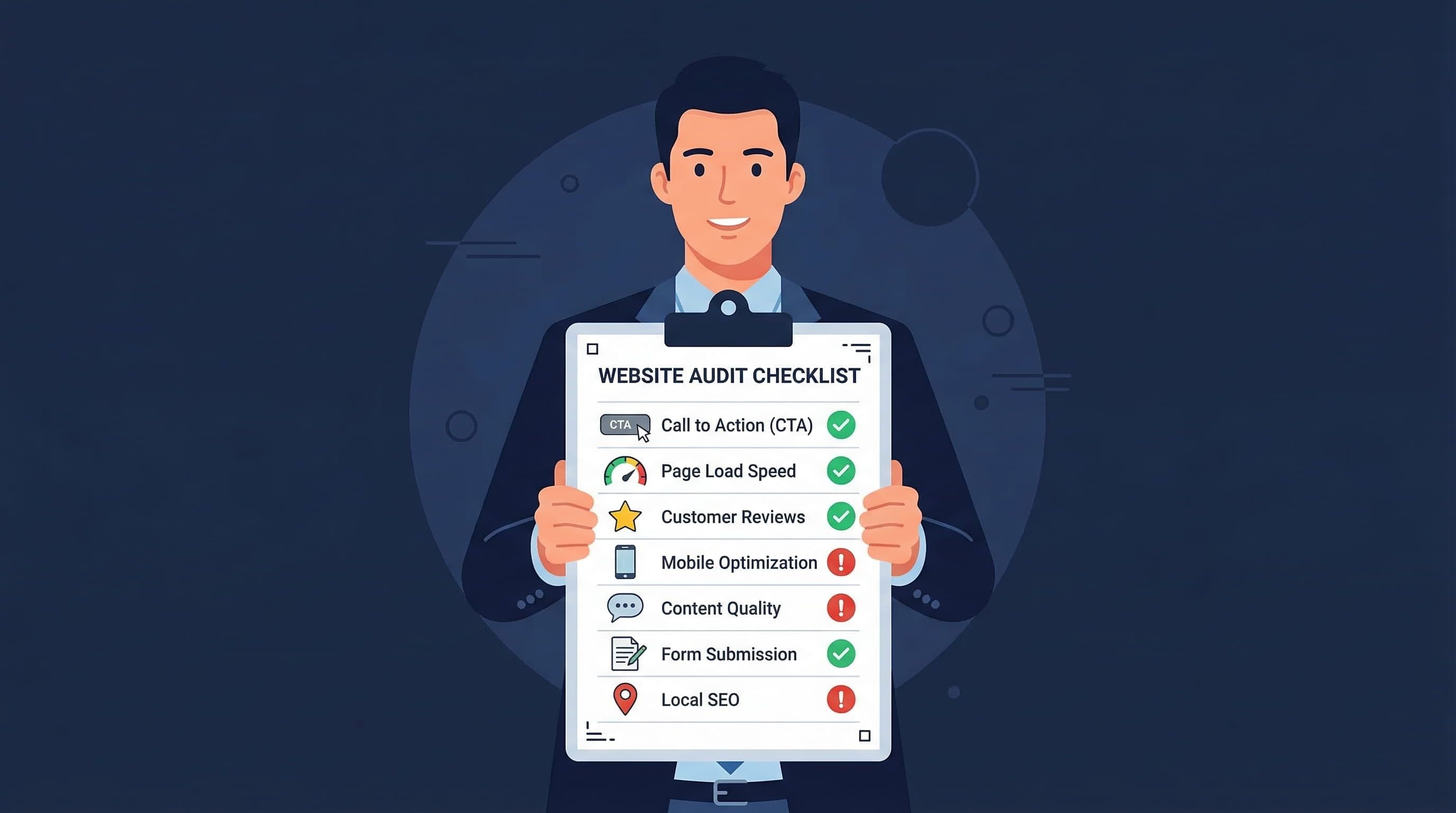
Before fixing anything, identify which specific problems are present on your site. This table maps each common failure to its visible symptom and the corresponding fix.
| Problem | Symptom | Fix |
|---|---|---|
| No clear CTA | Traffic but zero enquiries | Single prominent CTA on every page above the fold |
| Slow load speed | High bounce rate, low time-on-site | Image compression, caching, quality hosting |
| No trust signals | Visitors leave without contacting | Testimonials, sold properties, headshot, credentials |
| Weak mobile experience | Mobile traffic converts at near zero | Mobile-first design review and rebuild |
| Generic copy | No differentiation from competitors | Niche-specific copy addressing seller/buyer pain |
| Missing contact friction reduction | Form exists but no one fills it | Shorter form, phone number visible, response time stated |
| No local SEO signals | Not ranking for area searches | Location pages, Google Business, local schema markup |
Most real estate agents I work with have more than one of these problems active simultaneously. The most common combination is no clear CTA, weak mobile experience, and generic copy — which together produce a site that looks credible but converts at near zero.
Common Website Issues for Real Estate Agents and Brokers
The seven fixes above apply to all real estate sites, but CRE brokerage websites have specific lead generation problems that residential agent sites don't. A commercial real estate brokerage website not generating leads is almost always missing one of these: no property-specific landing pages for commercial listings, copy written for a general audience instead of investors and business tenants, and no credibility signals relevant to commercial transactions, deal size, asset classes handled, notable transactions. Commercial buyers and tenants have longer decision cycles and higher due diligence standards than residential buyers. The site needs to reflect that.
How to Fix Each Problem, Step by Step
Fix 1 — Add a Single Clear CTA Above the Fold on Every Page
Real estate website CTA comparison
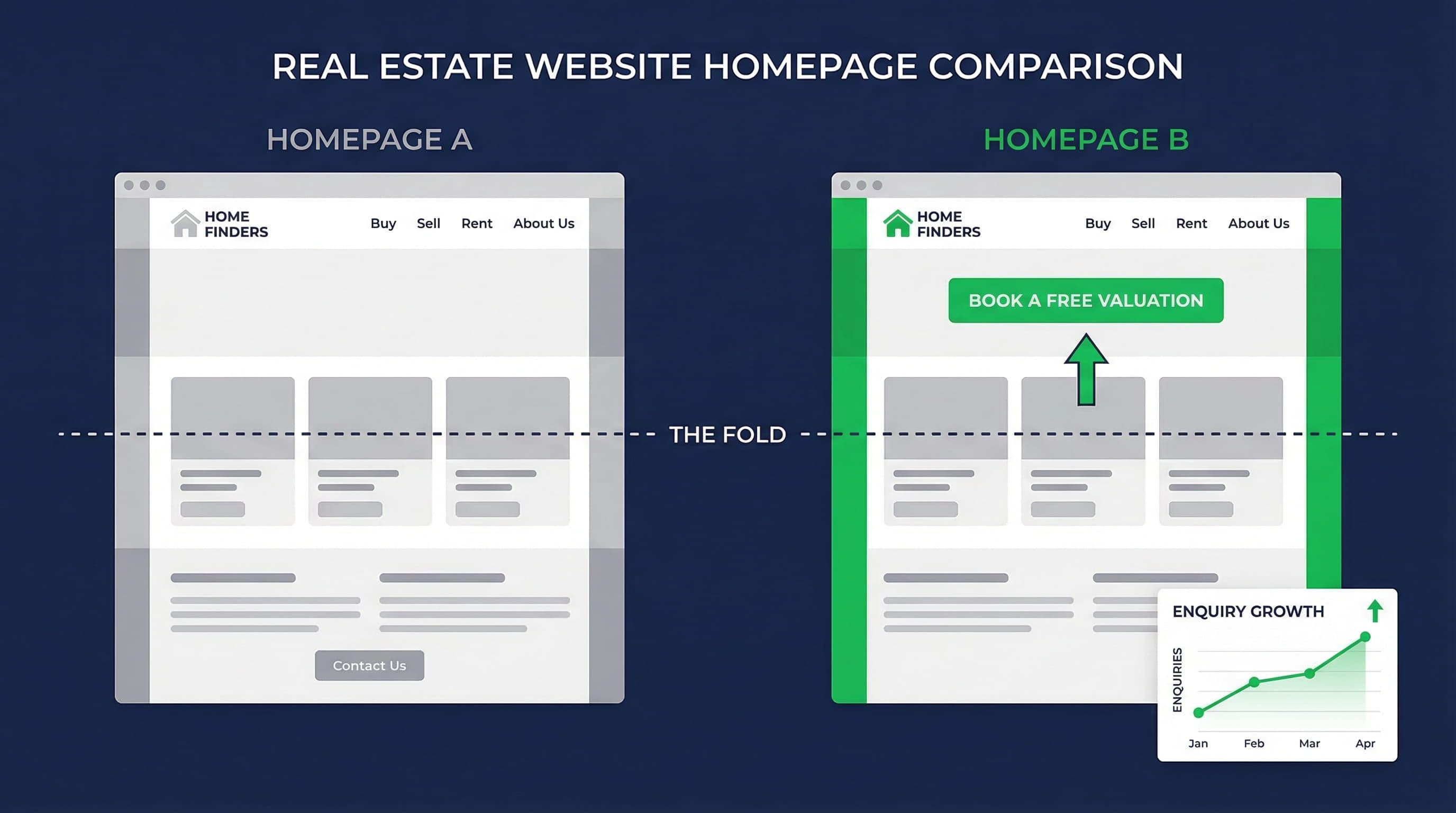
What to do: Identify the one action you want every visitor to take. For most real estate agents this is either booking a valuation call or requesting a property consultation. Place a single button with that action visible without scrolling on every page of the site, including the homepage, about page, and any area or neighbourhood pages. The button text should be specific: Book a Free Valuation, Get a Market Appraisal, or Speak to an Agent — not Contact Us or Get in Touch.
Why it matters: A visitor who arrives on a real estate site has a specific intent. They are considering buying, selling, or evaluating an agent. If the site does not immediately show them what to do next, they leave and find an agent whose site does. The average visitor makes this decision in seconds. An unclear or absent CTA guarantees the visit ends without conversion regardless of how much time the visitor spent on the site.
Pro Insight:
Test the CTA specificity. 'Book a Free Valuation' consistently outperforms 'Contact Us' on real estate sites because it names the outcome the seller wants rather than describing an administrative action. The more specific the button text, the lower the psychological barrier to clicking.
Fix 2 — Reduce Page Load Time Below Three Seconds
What to do: Test the site on Google PageSpeed Insights and GTmetrix. Note the load time on mobile specifically, not desktop. The most common causes of slow real estate sites are uncompressed property images, no caching plugin active, and budget shared hosting under-resourced for the site's actual traffic. Address these in order: compress all images using ShortPixel or Imagify, activate a caching plugin such as WP Rocket or LiteSpeed Cache, and confirm the hosting plan can handle the site's current traffic without throttling.
Why it matters: A one-second delay in mobile load time reduces conversions by approximately 20 percent. For a real estate site, 60 to 70 percent of visitors are on mobile. A site that takes five seconds to load on a phone is losing more than half its potential enquiries before a visitor even sees the homepage. Page speed is not a technical metric. It is a revenue metric.
Pro Insight:
Property photography is the largest load time culprit on real estate sites. A single uncompressed hero image can exceed 3MB. Compress images to under 200KB before uploading. Use WebP format where the theme supports it. Set images to lazy load so images below the fold do not load until the visitor scrolls to them.
Fix 3 — Add Trust Signals That Match the Luxury Market
What to do: A luxury real estate site requires trust signals calibrated to a high-net-worth audience. Generic five-star reviews from Trustpilot are not sufficient. Specific, named testimonials from clients whose properties are identified by area or value range are significantly more credible. Sold property case studies showing the listing price, result, and timeframe build authority in a way that general statements cannot. Professional headshots and credentials, including industry memberships, awards, and years of experience in the specific market, reinforce the agent's positioning.
Why it matters: A high-net-worth client considering entrusting an agent with the sale of a property worth $1 million or more is conducting due diligence on the agent before making contact. A site without credible, specific trust signals fails that due diligence review immediately. The visitor finds an agent whose site does pass the review, and makes contact there instead.
Pro Insight:
Specificity is the difference between trust signals that work and ones that do not. 'Excellent service, would highly recommend' is ignored. 'Sold our Mayfair flat in 11 days, 4% above asking price — John and Sarah M.' is credible. Ask previous clients for specific outcome testimonials rather than general satisfaction statements.
Fix 4 — Audit and Rebuild the Mobile Experience
Real estate website mobile experience broken
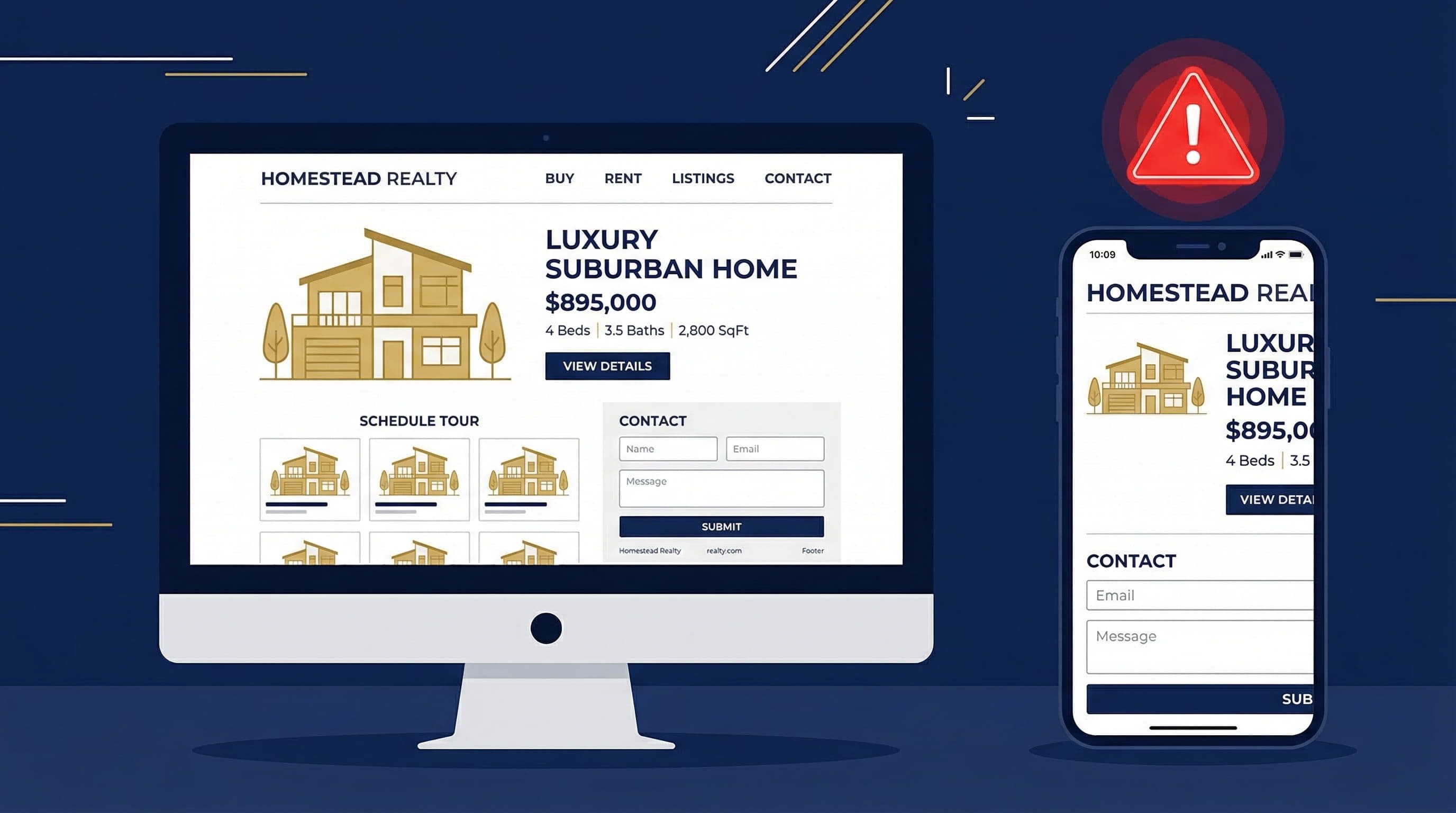
What to do: Open the site on an actual mobile phone, not a desktop browser's mobile preview mode. Tap every button. Fill in the contact form. Check whether the phone number is click-to-call. Verify that images scale correctly at mobile width. Confirm the navigation menu opens and closes without overlapping content. Note every element that does not work as expected and address each one individually.
Why it matters: A majority of real estate search now happens on mobile. A site that works on desktop but breaks on mobile is effectively offline for most of its potential visitors. The mobile audit on an actual device catches problems that developer tools miss: touch targets too small to tap accurately, forms that require horizontal scrolling to complete, navigation that obscures content on smaller screens.
Pro Insight:
The contact form is the highest-priority mobile element to test. Forms that work on desktop frequently have layout issues on mobile: fields that extend past the screen edge, submit buttons that are not visible without scrolling, and CAPTCHA challenges that are difficult to complete on a touch screen. Test the full form submission on mobile before assuming it works.
Fix 5 — Replace Generic Copy With Niche-Specific Positioning
What to do: Review every page of the site for generic language. Phrases like 'your trusted real estate partner,' 'we put clients first,' and 'years of experience in the market' appear on thousands of agent websites and communicate nothing specific. Replace this language with copy that names the specific market, the specific client type, and the specific outcome the agent delivers. 'Luxury property sales in South Kensington and Knightsbridge, specialising in international buyers and probate estates' is specific. It tells a visitor in three seconds whether this agent is right for them.
Why it matters: Generic copy does not differentiate. A seller comparing two agent websites will not remember the one that said 'trusted and experienced.' They will remember the one that described their specific situation and demonstrated knowledge of their specific market. Specificity creates the impression of expertise without requiring the agent to write a portfolio. It filters for the right clients and repels the wrong ones, which improves lead quality alongside volume.
Pro Insight:
The homepage headline is the highest-leverage copy element on the site. A weak headline like 'Welcome to [Agency Name]' wastes the most valuable space on the page. A strong headline addresses the seller's primary concern: 'Sell Your London Property Faster, With Less Stress, For the Best Possible Price.' That is what a seller wants to see, not a welcome message.
Fix 6 — Reduce Contact Form Friction
What to do: Count the fields in the contact form. For an initial enquiry, the maximum effective field count is three to four: name, email or phone, and one question about what they need help with. Every additional field reduces completion rates. Remove fields that gather information useful to the agent but not necessary to initiate contact: property value ranges, preferred viewing times, how they heard about the agent. Gather this during the first conversation, not as a barrier to starting it.
Why it matters: Contact form completion rates drop measurably with each additional field. A luxury real estate buyer or seller who is ready to make an enquiry but encounters a ten-field form will often close the tab rather than complete it. The form's purpose is to start a conversation, not to qualify the lead before any contact has been made. Reduce it to the minimum required to respond, and let the conversation do the qualification.
Pro Insight:
Add a response time expectation beside the form submit button. 'We respond within one business day' or 'You will hear from us within two hours' reduces the anxiety that prevents some visitors from submitting. High-net-worth clients in particular want to know that their enquiry will be handled promptly rather than entering a generic inbox.
Fix 7 — Build Local SEO Signals Into the Site Structure
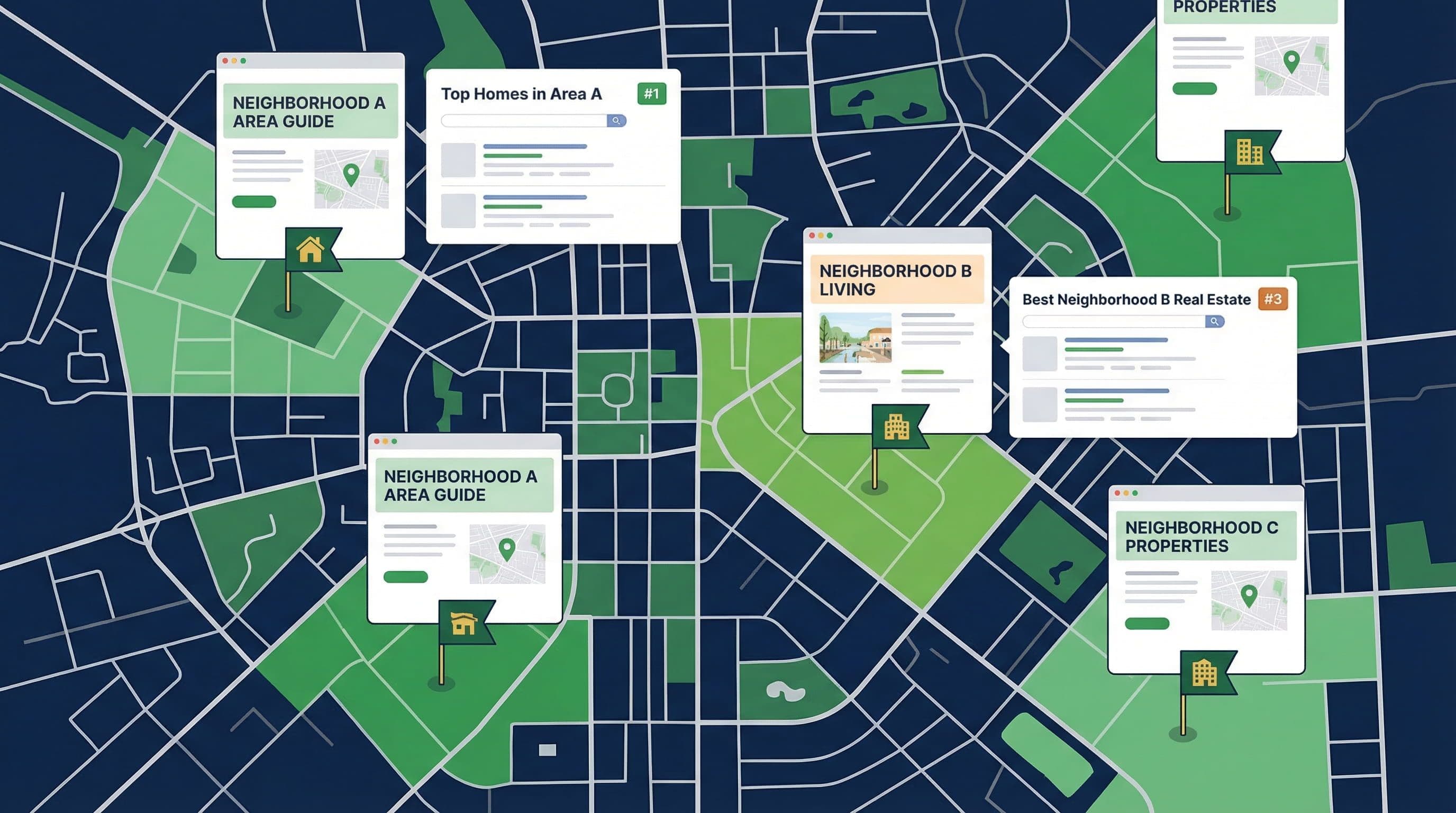
Real estate website area pages for local SEO
What to do: Create dedicated area or neighbourhood pages for every location the agent actively serves. Each page should be specific to that location: property type, average prices, recent sold examples where possible, and why this agent is the right choice for that area. Ensure the Google Business Profile is complete, verified, and linked to the website. Add LocalBusiness schema markup to the homepage to help search engines understand the geographic service area. Keep the name, address, and phone number consistent across the website, Google Business, and any directory listings.
Why it matters: Most real estate search queries include a location. 'Luxury flats for sale in Chelsea,' 'property agent South Kensington,' 'best estate agent Knightsbridge.' A site without location-specific pages cannot rank for these queries regardless of how well the homepage performs. Area pages are the most direct path from organic search to qualified real estate leads because they match the searcher's intent precisely.
Pro Insight:
Area pages work best when they include genuinely local information: current market conditions, typical property types, recent comparable sales. A page that is simply a generic agency description with a location name inserted is not useful to a visitor and will not rank. Write for the person considering buying or selling in that specific area, not for the search engine.
Common Mistakes That Keep Real Estate Sites Silent
Treating the Website as a One-Time Project
A real estate website built and left without updates is a site that gradually loses ground to competitors who are actively improving theirs. Market conditions change. New competitors launch stronger sites. Google's ranking factors evolve. A site built two years ago and never updated is competing with content, speed optimisations, and trust signals that did not exist when it launched. The site is not static. The competition around it is not static. Treating it as a finished project rather than an active marketing asset is one of the most consistent lead generation mistakes in the real estate sector.
Prioritising Design Over Conversion
A visually impressive real estate site that converts zero enquiries has negative ROI. Design is the packaging. Conversion is the product. An agent who spends $5,000 on a beautiful site with no CTA strategy, weak copy, and a buried contact form has less than an agent who spends $449 on a correctly structured site with specific positioning and a tested enquiry flow. Evaluate sites on enquiries generated per month, not on how good they look in a portfolio screenshot.
Ignoring the Traffic Source
A site with no traffic has a different problem than a site with traffic that does not convert. Before fixing conversion elements, confirm there is actual traffic reaching the site. Google Search Console shows impressions, clicks, and the queries generating them. If impressions are low across the board, the problem is discoverability, not conversion. If impressions are reasonable but clicks are low, the problem is the title tag and meta description in search results. If clicks are good but enquiries are zero, the problem is on-site conversion. Diagnose before fixing.
Using a Generic Theme Without Real Estate Specific Conversion Structure
A general-purpose WordPress theme installed with property photos and contact details is not a real estate lead generation site. It is a digital business card. Real estate lead generation requires specific structural elements: above-the-fold CTA, area pages, trust signal placement, property search or portfolio display, and a contact flow designed around the seller or buyer journey. These elements do not appear automatically in a general theme. They need to be built with the conversion goal in mind from the start.
The Exact Setup Used on High-Converting Real Estate Sites
This is the standard configuration for a service business real estate site built for lead generation:
- Theme: GeneratePress or Astra configured with a clean, fast base. No page builder bloat. Custom sections built with native blocks or lightweight custom code.
- Hosting: SiteGround Business or equivalent managed hosting. Server-level caching active. CDN enabled.
- Images: All property images compressed to under 200KB via ShortPixel before upload. Lazy loading enabled. WebP format where supported.
- CTA: Single primary CTA button visible above the fold on every page. Button text specific to the action. Secondary CTA in the footer.
- Trust signals: Named client testimonials with property area and outcome, sold property examples, agent credentials and photo above the fold.
- Contact form: Three fields maximum for initial enquiry. Response time stated. Phone number click-to-call on mobile.
- Area pages: One dedicated page per target location, each with specific market content and a CTA.
- Local SEO: Google Business Profile linked, NAP consistent across all pages, LocalBusiness schema on homepage.
- Analytics: Google Analytics 4 with goal tracking on form submissions and phone click events.
A site configured this way generates enquiries. Not immediately through organic search if it is new, but from every visitor who arrives regardless of source. The conversion infrastructure works whether the traffic comes from Google, a referral, or a business card.
Don't Have Time to Deal With This?
If this article has identified specific problems on your real estate site but fixing them feels like another project you do not have time for, that is a reasonable place to be.
The $449 WordPress Website Package is built for service business owners, including real estate agents, who need a site configured for lead generation from day one. Clear CTA on every page. Trust signals placed correctly. Mobile experience tested and working. Contact form friction removed. Local SEO structure in place.
One fixed price. No ongoing retainer. No agency overhead.
View the $449 WordPress Website Package
About the Author
By Sheikh Hassaan, Digital Architect for Small Businesses
Sheikh Hassaan, Digital Architect for Small Businesses. I help service businesses launch fast, secure, conversion-focused websites without the agency price tag.
Related Articles
- How to Set Up WordPress for a Luxury Real Estate Website
- The Best WordPress Theme for Luxury Real Estate Websites
- 7 Signs Your WordPress Website Has Been Hacked
Frequently Asked Questions
Why is my real estate website not generating leads?
The most common causes are no clear call to action above the fold, slow mobile load speed, missing trust signals, and generic copy that does not differentiate from competitors. Most real estate sites have more than one of these problems active simultaneously. Diagnosing which specific elements are failing before making changes gives you a faster path to results.
How do I get more enquiries from my real estate website?
Start with the contact form and the CTA. Reduce the form to three fields, make the CTA specific and visible without scrolling on every page, and add a response time expectation beside the submit button. These three changes typically produce the fastest improvement in enquiry volume without requiring a redesign.
What is the best website for real estate leads?
The best real estate lead generation website is not a platform, it is a correctly configured site on your own domain. Third-party platforms like Zillow or Rightmove generate leads for the platform, not for you specifically. A self-hosted WordPress site with clear CTAs, area pages, trust signals, and fast mobile load speed generates leads that come directly to you with no platform fees or competitor listings alongside yours. For agents serious about lead generation, owning the site is significantly more valuable long-term than renting space on a directory.
What website issues hurt real estate leads the most?
The three issues that kill real estate leads most consistently are: a missing or unclear call to action above the fold, a slow mobile experience, and generic copy that doesn't differentiate the agent. Any one of these alone significantly reduces enquiry rates. All three together produce a site that generates near zero leads regardless of traffic volume. Fix these before anything else.
Why is my CRE brokerage website not generating leads?
Commercial real estate brokerage sites fail for the same reasons residential sites do, plus a few specific to the CRE market: no dedicated pages for commercial property types (office, retail, industrial, mixed-use), copy that doesn't address investor or tenant decision criteria, and missing transaction credibility signals like deal size and notable clients. CRE buyers and tenants do significantly more research before making contact, the site needs to answer their specific questions before they pick up the phone.
Does page speed affect real estate website leads?
Yes, directly. A one-second delay in mobile load time reduces conversions by approximately 20 percent. Most real estate visitors are on mobile, so a slow site is losing a significant share of potential enquiries before they see the homepage. Compress property images, activate caching, and confirm the hosting plan is adequate for the site's traffic.
Should a real estate website have area pages?
Yes. Area pages are the most direct path from organic search to qualified leads because most property search queries include a location. A site without dedicated area pages cannot rank for location-specific searches regardless of how well the homepage performs. Each area page should include genuine local content, not just a generic agency description with a location name.
How long does it take for a real estate website to generate leads?
A new site with correct conversion structure can generate leads from day one through direct traffic, referrals, and paid promotion. Organic search leads typically take three to six months as the site builds authority and rankings. Sites that have existing traffic but poor conversion structure can see enquiry improvement within weeks of fixing the specific problems identified in a conversion audit.