
Dental-clinic-website
Website SEO Guide for Dentists to Get More Patients Online
Website SEO guide for dentists: schema markup, FAQ pages, review strategy, competitor analysis, and the exact steps to get more patients from Google in 2026.
Most dental practices focus on the basics and wonder why competitors keep outranking them. This guide covers the advanced moves that actually separate page one practices from everyone else.
By Sheikh Hassaan, digital architect for small businesses
Quick Answer
A complete dental website SEO strategy goes beyond Google Business Profile and treatment pages. It includes schema markup so Google understands your practice data, FAQ pages that rank for the questions patients type into voice search, a systematic review strategy that builds volume over months, competitor gap analysis to find searches you are missing, and before and after content for cosmetic treatments that converts browsers into booked consultations.
Why Is Getting Found on Google So Hard for Dental Practices?
Dentistry is one of the most competitive local search markets in every city in the US, UK, Canada, and Australia. In a city of 200,000 people there might be 60 dental practices all competing for the same handful of search positions. Most of them have done the basics. They have a Google Business Profile. They have a website. Some have individual treatment pages.
The practices that consistently sit at the top of local search results are not just doing the basics better. They are doing things most practices have never heard of. Schema markup that tells Google exactly what type of business you are and what services you offer. FAQ pages structured specifically to appear in voice search results. A review acquisition system that generates five to ten new reviews per month consistently rather than in bursts. Content that targets the informational searches patients make before they are ready to book.
A dental practice in London had done everything a standard SEO guide told them to do. Google Business Profile verified. Treatment pages built. Page titles updated. They sat at position seven for their main local search query for eight months without moving. A competitor who had been in position three for years kept pulling in the calls. When we audited the competitor site, the difference was schema markup, a comprehensive FAQ section, and 140 Google reviews versus 22. These are not technical mysteries. They are specific gaps that can be closed.
Want to know exactly which SEO gaps are keeping your practice off page one?
Send me your website URL on WhatsApp for a free dental SEO audit. I will check your schema, your content gaps, your review count, and your competitor positioning, and tell you the three things that would move the needle fastest.
WhatsApp message to send: Hi Sheikh, dental SEO audit please: [your website URL]
What Does a Complete Dental Website SEO Strategy Look Like?
This section covers the six elements that separate a dental practice with strong organic visibility from one that is stuck doing the basics and wondering why nothing moves. Each one builds on the others.

Dental website schema markup showing star ratings, FAQ answers, dentist category, and location data feeding into an enhanced Google search listing
Schema markup for dental practices
Schema markup is code that sits invisibly on your website and tells Google precisely what your business is, what it offers, where it is located, and what patients say about it. Without schema, Google has to guess this information from your content. With schema, you give it directly. Google uses this structured data to populate rich results in search, including star ratings shown directly in search results, FAQ answers displayed below your listing, and enhanced local business information.
For a dental practice, the most important schema types are Local Business with the Dentist subtype, which tells Google your practice is specifically a dental business. MedicalOrganization schema adds your medical specialty information. FAQPage schema on your FAQ pages makes those answers eligible to appear directly in Google search results without the patient needing to click through. Review schema pulls your ratings into your search listing visually.
Adding schema to a WordPress dental website takes about two hours with a plugin like Rank Math or Schema Pro. It is one of the highest-return technical SEO tasks available because it directly affects how your listing looks in search results, which affects click-through rate. A listing that shows star ratings and FAQ answers gets more clicks than a plain text listing at the same position.
Practical tip: After adding schema, use Google's Rich Results Test at search.google.com/test/rich results to verify it is reading correctly. Fix any errors before waiting for Google to recrawl. Schema errors cancel out schema benefits.
Patient FAQ pages that rank for voice search
Voice search has changed how patients find dental information. When someone asks their phone how much do dental implants cost in Sydney or is Invisalign painful, Google looks for a page that directly answers that question in plain conversational language. A dental practice with a comprehensive FAQ section structured in question-and-answer format is positioned to capture these searches in a way that a standard treatment page is not.
Build a dedicated FAQ page for each major treatment your practice offers. The implants FAQ page answers: how much do dental implants cost, how long do dental implants last, are dental implants painful, what is the recovery time for dental implants, and am I a good candidate for dental implants. Each question gets a two to three paragraph direct answer written in plain language. These pages rank for long-tail voice queries that treatment pages rarely capture.
A single well-built FAQ page for dental implants can rank for thirty to fifty different question-based search queries simultaneously. Most of these queries have low competition because most dental websites do not have dedicated FAQ pages. This is one of the least competitive and most rewarding content opportunities in dental SEO.
Review strategy that actually builds volume
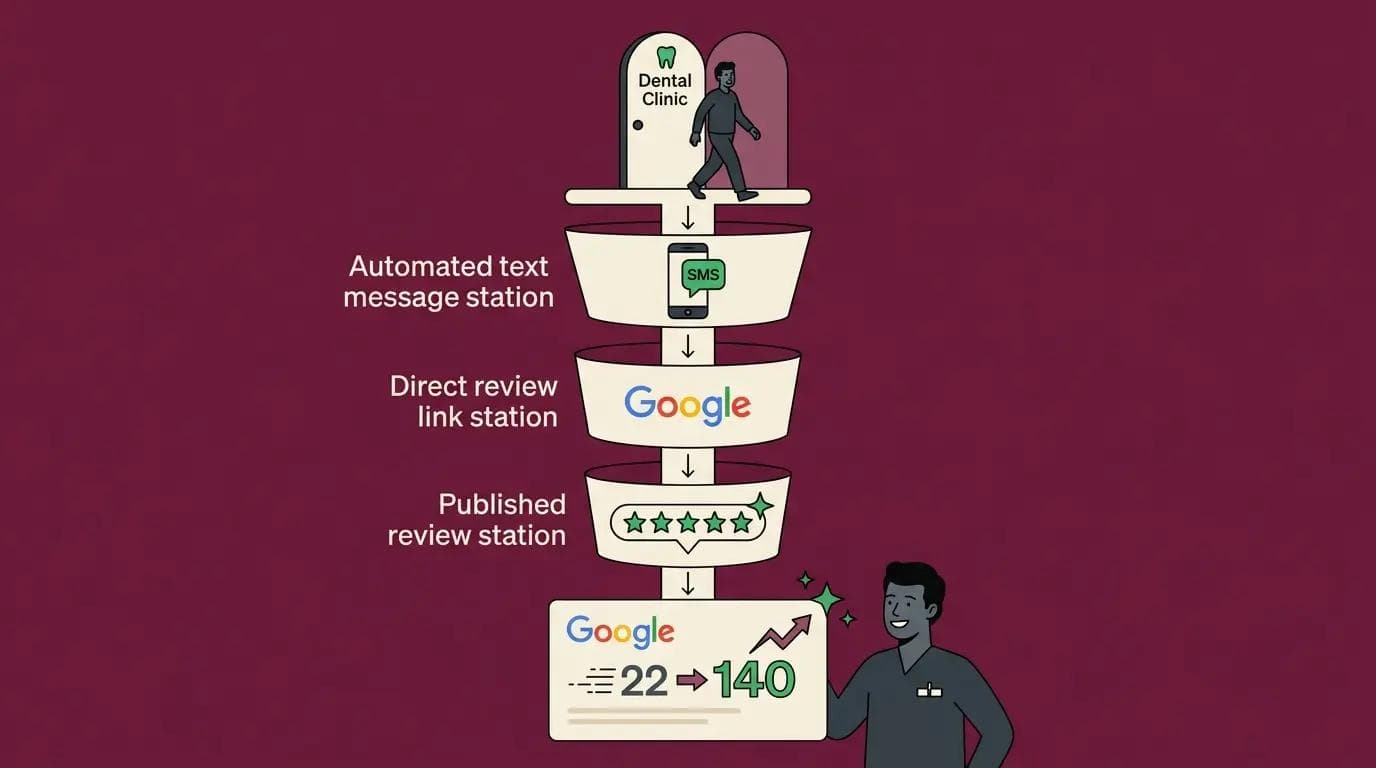
Dental practice review funnel showing automated text message system converting patient visits into Google reviews growing from 22 to 140 reviews over time
Most dental practices ask patients for reviews inconsistently. A team member mentions it at checkout sometimes. An email goes out occasionally. The result is a Google Business Profile with 18 reviews after three years of operation while a competitor down the road has 200. Review volume is one of the strongest local ranking signals Google uses. A practice with 150 reviews at 4.7 stars will consistently outrank a practice with 25 reviews at 5.0 stars for the same local searches.
A systematic review strategy looks like this. After every appointment, an automated text message goes to the patient with a direct link to your Google review page. The message is short: Thanks for visiting us today. If you have a moment, we would love to hear about your experience. The link opens the Google review form directly with one tap. This single automation, which takes about one hour to set up through your practice management software or a tool like NiceJob, generates five to fifteen new reviews per month consistently.
Respond to every review within 48 hours. For positive reviews, thank the patient by first name and mention the specific treatment if appropriate. For negative reviews, acknowledge the concern, apologize without admitting fault, and invite them to contact the practice directly. Google ranks practices that engage with reviews higher than those that ignore them. The responses also show potential new patients how the practice handles problems, which is a significant trust signal.
Competitor gap analysis for dental searches
A competitor gap analysis answers one question: what search queries are your top-ranked competitors appearing for that you are not? This is the fastest way to find content opportunities because you are not guessing what patients search for. You are looking at what is already working for the practices outranking you and building better versions of those pages.
Go to Google and search for your main service queries: dentist in your city, dental implants your city, teeth whitening your city. Open the top three results for each query. Read what they have that you do not. A treatment page with 800 words of detailed content, patient testimonials specific to that treatment, a cost range, and a FAQ section will consistently outrank a treatment page with 200 words and no additional supporting content. Build what they have and add what they are missing.
Free tools like Google Search Console show you which queries you are already appearing for and at what position. Queries where you appear at positions four to ten are your fastest wins. You are already relevant for these searches. Small improvements to those specific pages, adding more content, fixing the page title, adding a patient quote, can move you from position eight to position three faster than building a new page from scratch.
Location pages for multi-location practices
A dental group with practices in three suburbs has a significant SEO opportunity that most groups ignore. Instead of one website for the whole group, build a dedicated location page for each practice. Each location page should have the suburb name in the page title and H1, the specific address and phone number for that location, photos of that specific practice interior and team, patient reviews mentioning that location, and local content referencing the surrounding area.
Google treats each location page as a separate local entity. A group with a location page for each suburb can appear in local searches for dentist in each of those suburbs independently, multiplying the group's organic search footprint without any additional advertising. Most multi-location groups either have one generic page or identical copy across all location pages, which Google treats as duplicate content and ranks poorly.
Before and after content for cosmetic treatments
Cosmetic dental treatments including teeth whitening, veneers, Invisalign, and composite bonding have a specific conversion dynamic that informational content alone cannot address. A patient considering veneers has made an emotional decision before they have made a rational one. They want to see real results from real patients before they book a consultation. A before and after gallery on your veneers page converts browsers into enquiries at a significantly higher rate than text descriptions alone.
Beyond galleries, consider publishing patient case study content. A short-written story of a patient's journey through Invisalign treatment, including their concerns before starting, their experience during treatment, and their result, reads as genuine social proof that marketing copy cannot replicate. With patient consent, these case studies can include before and after photos and specific details that make the experience feel real and achievable to someone considering the same treatment.
This content also ranks for long-tail searches like Invisalign results before and after and veneers transformation examples that bring patients with high purchase intent directly to your treatment pages. These visitors are further along in their decision process than someone searching general information, which means they convert to enquiries at a higher rate.
What Is the Fastest Way to Get More Dental Patients From Google?

Dentist comparing his website performance against a competitor in Google Search Console identifying missing FAQ pages, schema markup, and review volume as ranking gaps
The fastest single action a dental practice can take to increase patient enquiries from Google is to fully optimize their Google Business Profile and systematically collect reviews. A complete profile with recent photos, active posts, and 50 or more reviews will rank above incomplete profiles with fewer reviews for most local searches within 30 to 60 days.
The second fastest action is fixing your treatment page titles. If your dental implants page title currently says Dental Implants or Services, changing it to Dental Implants in your city, Cost and Consultation or similar can improve your ranking for that specific query within two to four weeks as Google recrawls the page. Page titles are one of the most direct ranking signals Google uses and most dental websites have generic ones.
The third fastest action is adding FAQ schema to any pages that answer patient questions. Once Google crawls the updated schema, your listing can start showing FAQ answers directly in search results, which increases both visibility and click-through rate without any change in your actual ranking position.
How Long Does Dental SEO Take to Show Results?
Google Business Profile optimization and review collection can show measurable results in 30 to 60 days for practices in moderately competitive markets. Schema markup changes can affect how your listing appears in search results within two to four weeks of Google recrawling your pages. These are the fastest-moving elements of dental SEO.
New content pages, including treatment pages, FAQ pages, and location pages, typically take 60 to 120 days to rank meaningfully for their target queries. Google needs to crawl the page, index it, assess it against existing pages for the same queries, and gradually test it in search results. A new dental implants FAQ page targeting a moderately competitive local query will usually start appearing on page two within 60 days and move to page one within four to six months with no further changes needed.
The compounding effect of dental SEO becomes clear at the six-to-twelve-month mark. A practice that has consistently added content, collected reviews, and maintained their Google Business Profile for a year will typically have three to five times the organic search visibility they started with. Each piece of content and each new review adds to the total rather than replacing previous work.
What Are the SEO Mistakes Dental Practices Make That Kill Rankings?
Duplicate content across location pages
A dental group that copies the same content onto multiple location pages with only the suburb name swapped creates a duplicate content problem that Google penalizes. If your Bondi Junction location page and your Newtown location page have identical text, Google will pick one to rank and suppress the other. Each location page needs genuinely unique content about that specific location, team, and patient community to earn independent rankings.
Ignoring negative reviews rather than responding
A dental practice with two unanswered one-star reviews and forty positive reviews looks less trustworthy to potential patients than one with the same negative reviews that received thoughtful, professional responses. Patients read negative reviews specifically to see how the practice handles problems. An ignored negative review signals indifference. A well-handled response signals accountability and patient care, which is exactly the trust signal a new patient is looking for.
Publishing thin treatment pages and expecting them to rank
A dental implants page with 150 words of generic content will not rank above a competitor page with 800 words covering costs, procedure steps, recovery time, patient eligibility, and a FAQ section. Google evaluates content depth as a quality signal. If your treatment pages are shorter and less informative than the pages currently ranking for the same query, no amount of technical SEO will override that content gap. Write treatment pages that genuinely answer every question a patient might have before booking.
How I Handle SEO for Dental Websites
Every dental website I build is structured for search from the foundation upward. Before any design work starts, I map the treatment searches relevant to the practice's location and specialty, identify which pages need to be built, and plan the internal linking structure that connects them. The site architecture is built around how patients search, not around how the practice wants to present itself.
Schema markup is added to every page during the build, not as an afterthought. FAQ sections are structured for featured snippet eligibility. Google Business Profile is connected and configured before launch. The review request workflow is set up as part of the handover, so the practice starts collecting reviews from day one rather than remembering to ask occasionally.
I build with WordPress or Next.js depending on the project. Full ownership of every account goes to the practice from day one. The site is built to be maintained and updated by the practice team without developer dependency for routine content changes.
Want to know what your competitors are ranking for that you are missing?
Send me your website and your top competitor's website on WhatsApp. I will do a free gap analysis and tell you the specific pages and content your practice is missing that are sending patients to them instead of you.
WhatsApp message to send: Hi Sheikh, competitor SEO analysis please: [your URL] vs [competitor URL]
If a new site or rebuild makes more sense, professional dental websites start from $449 with all SEO foundations built in.
Do You Want This Handled for You?
The $449 web design package builds every technical SEO foundation into your dental website from day one. Schema markup, individual treatment pages, FAQ structure, Google Business Profile connected, review display, fast mobile load, and full ownership.
No separate SEO agency needed for the foundations. No ongoing monthly retainer for work that should have been done once at the start.
View the $449 Web Design Package
About the Author
Sheikh Hassaan, Digital Architect for Small Businesses
I help service businesses launch fast, secure, conversion-focused websites without the agency price tag.
Related Articles
- How to Rank Your Dental Website on Google Without Ad Spend
- Professional Website Design for Dentists (With Free Website Audit)
- Is It Worth Paying for a Website in 2026?
Frequently Asked Questions
What is the most effective SEO strategy for dentists?
The most effective dental SEO strategy combines a fully optimized Google Business Profile with consistent review collection, individual treatment pages for every service, schema markup so Google understands your practice data, and FAQ pages targeting the specific questions patients search for before booking. Practices that execute all five of these consistently outrank competitors who focus on only one or two.
How do dental FAQ pages help with SEO?
Dental FAQ pages rank for the conversational question-based searches patients makes before booking, especially through voice search. A page that directly answers how much do dental implants cost in your city or is Invisalign painful can rank for thirty to fifty different long-tail queries simultaneously. FAQ schema markup also makes these answers eligible to appear directly in Google search results, increasing visibility without requiring a click.
How many Google reviews does a dental practice need to rank well?
There is no fixed number but in most competitive local markets, a dental practice needs at least 50 reviews to compete for top positions and 100 or more reviews to consistently rank above well-established competitors. Volume matters as much as rating. A practice with 120 reviews at 4.6 stars will typically outrank a practice with 20 reviews at 5.0 stars for the same local search queries.
What is schema markup and why does a dental website need it?
Schema markup is code added to your website that tells Google exactly what type of business you are, what services you offer, where you are located, and what your ratings are. Without it, Google guesses this information from your content. With it, Google can display star ratings, FAQ answers, and enhanced business information directly in search results, which increases click-through rates and helps your listing stand out from competitors who do not have schema set up.
How often should a dental practice update its website for SEO?
A dental practice should post to Google Business Profile at least twice a month, add or update patient reviews continuously, and review treatment page content every six months to ensure it remains accurate and competitive. Adding one new FAQ page or blog article per month compounds search visibility significantly over a twelve-month period. Dental websites that remain static for long periods gradually lose rankings to competitors who publish content regularly.