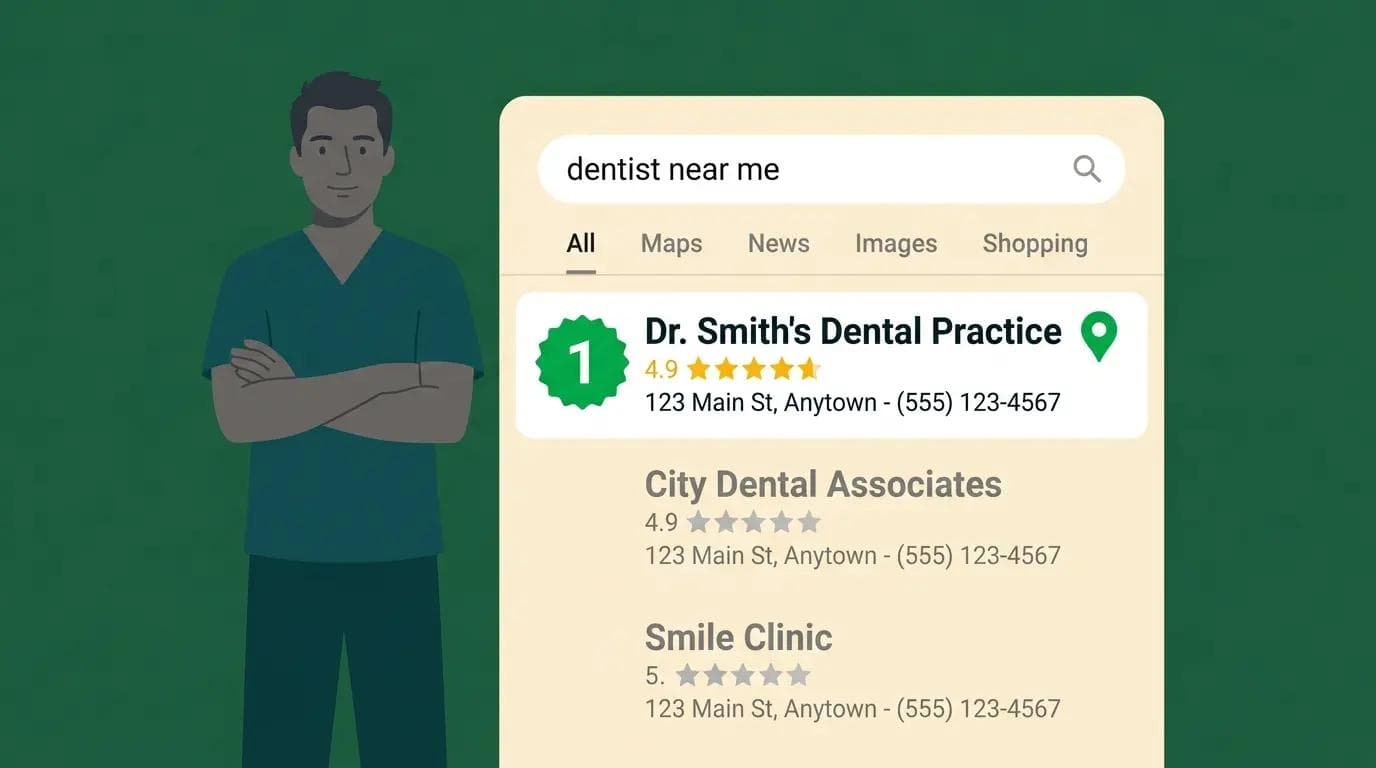
Google Business Profile Ranking
How to Rank Your Dental Website on Google Without Ad Spend
SEO for dentists explained plainly. How to optimize your dental website design for Google, rank for local searches, and get new patients without paid ads.
Most dental practices are paying for Google Ads to get patients who could be finding them for free. Here is what your site is missing.
By Sheikh Hassaan, digital architect for small businesses
Quick Answer
To get your dental practice found on Google without ads, you need six things working together: a fully set up Google Business Profile, individual pages for each treatment you offer, correct page titles and meta descriptions on every page, fast mobile load speed, a steady stream of patient reviews, and your sitemap submitted to Google Search Console. Most dental websites are missing at least three of these.
Why Are Dentists So Reliant on Google Ads When Organic Search Could Do the Same Job?
A dental practice in Toronto was spending $1,800 per month on Google Ads to stay visible for local searches. The ads worked but the moment they paused the campaign, the phone stopped ringing. They had been running ads for two years and had nothing to show for it in terms of organic visibility. Their website had not changed in that time and Google had no reason to rank it above competitors who were actively publishing content and building their local search presence.
SEO for dentists is not complicated but most dental practices either ignore it entirely or outsource it to agencies charging $800 to $2,000 per month for work that could have been done once properly at the start. The six steps below cover the core of what dental website SEO actually requires. None of them need an ongoing monthly retainer. They need to be set up correctly and maintained regularly.
The difference between a dental practice that gets a steady flow of organic patient enquiries and one that pays for every click is almost always the same thing: the first practice has individual treatment pages, a properly configured Google Business Profile, and fast mobile performance. The second has a nice-looking homepage and nothing else working in its favour.
Not sure why your dental site is not showing up on Google?
Send me your website URL on WhatsApp for a free homepage audit. I will check your SEO setup, your treatment pages, your Google Business Profile connection, and your mobile speed, and tell you exactly what is holding your rankings back.
Send a WhatsApp for Your Free Audit
How Can Dentists Optimize Their Website for SEO Without Hiring an Agency?

Seo optimized dental clinic website
These six steps cover the core of dental website SEO. They are in order of impact. Do them in this sequence and you will see measurable improvement in local search visibility within 60 to 90 days.
Step 1: Set up and verify Google Business Profile
Google Business Profile is the single highest-impact action a dental practice can take for local search visibility. It is what controls whether you appear in the Google Maps pack, which shows above the standard search results for local queries like dentist near me or dentist in your suburb. A practice without a verified and fully completed Google Business Profile is invisible to a large share of local patients searching on mobile.
Set your category to Dentist as the primary category. Add every relevant secondary category: dental clinic, cosmetic dentist, orthodontist, pediatric dentist, and emergency dental service if applicable. Upload at least ten photos including your exterior, your reception, your treatment rooms, and your team. Add your opening hours including any Saturday or emergency availability. Connect your website to the profile.
Post to your Google Business Profile at least twice a month. These posts appear in your listing and signal to Google that the practice is active. A practice that posts regularly consistently outranks a practice with a static, unupdated listing at the same quality level in everything else.
Step 2: Build individual pages for each treatment
This is the step that most dental websites skip and it is the most consequential for organic search. A patient searching dental implants in Melbourne is not going to find your services page that lists twenty treatments in one scroll. They are going to find a page that is entirely about dental implants, answers their questions about the procedure, explains what it costs, and tells them how to book.
Every main treatment your practice offers needs its own page. At minimum: general dentistry, teeth cleaning and hygiene, teeth whitening, dental implants, Invisalign or clear aligners, veneers, emergency dentistry, and children's dentistry. Each page should be 600 to 1,000 words, include your location naturally in the content, answer the questions patients ask about that treatment, and end with a clear call to book.
Once these pages exist, Google can rank you for dozens of specific treatment searches simultaneously. This is how practices with properly structured dental websites accumulate organic visibility without ongoing ad spend. The pages do the work once they are built and indexed.
Real example: A dental practice in Brisbane had a single treatments page. After splitting it into eight individual treatment pages with location-specific content, their organic impressions in Google Search Console increased from 340 per month to 2,800 per month within four months. Zero ad spend. Same practice.
Step 3: Fix your page titles and meta descriptions
Every page on your website has a title that appears in Google search results. Most dental websites have page titles that say something like Services or About Us. These titles tell Google and your potential patients nothing specific. A page title for your dental implants page should say something like Dental Implants in Manchester, or Dental Implants Melbourne: Cost and Procedure Guide. Specific titles rank better and get more clicks than generic ones.
The meta description is the short text that appears under your title in search results. It does not directly affect ranking but it directly affects whether someone clicks on your result. Write each meta description as a one or two sentence answer to what that patient is looking for, and include a clear reason to click: costs explained, same-week appointments, free consultation, or whatever your practice genuinely offers.
Use an SEO plugin like Yoast or Rank Math on WordPress to set these for every page without touching code. It takes one to two hours to go through every page on a typical dental site and update all titles and descriptions. This is one of the highest-return SEO actions you can take for time spent.
Step 4: Get your site loading fast on mobile
Google uses mobile page speed as a direct ranking factor. A dental website that loads slowly on a phone ranks lower than a faster competitor with similar content quality. Test your site at pagespeed.web.dev. If your mobile score is below 70, you have a speed problem that is actively costing you rankings.
The most common cause of slow dental websites is uncompressed images. A homepage with five large photos that have not been compressed can add three to five seconds to load time on mobile. Every image should be under 200KB before it is uploaded to your site. Use WebP format where possible. On WordPress, a plugin like Smush or ShortPixel can compress existing images automatically.
Cheap shared hosting is the second most common cause. A dental practice website on a $3 per month shared hosting plan will always be slower than one on a quality managed WordPress host charging $15 to $30 per month. The hosting cost difference is small. The speed difference is significant for both patient experience and search rankings.
Step 5: Collect and display patient reviews
Google reviews are one of the most significant local ranking signals for dental practices. A practice with 80 reviews at a 4.8 average consistently outranks a practice with 12 reviews at 5.0 for local searches in the same area. The volume of reviews matters as much as the rating. Ask every satisfied patient to leave a Google review. Make it easy by sending them a direct link to your Google Business Profile review page after their appointment.
Display your best reviews on your website homepage and on relevant treatment pages. A patient considering Invisalign who sees a review from another patient describing their Invisalign experience at your practice is more likely to book than one who sees only generic five-star scores. Specificity in reviews builds trust in ways that ratings alone cannot.
Respond to every review, positive and negative. Practices that respond to reviews consistently rank higher than those that do not. A thoughtful response to a negative review shows potential patients that you take patient experience seriously, which often converts a negative review into a trust-building signal rather than a deterrent.
Step 6: Submit your sitemap to Google Search Console
Google Search Console is a free tool that shows you exactly which of your pages Google has indexed, which searches your site appears for, and which pages have technical problems. Every dental website should have Google Search Console set up and the sitemap submitted. Without it, you are flying blind on how Google sees your site.
A sitemap is a file that lists every page on your website and tells Google to crawl them. On WordPress, an SEO plugin generates this automatically. The URL is usually yourdomain.com/sitemap.xml. Log in to Google Search Console, go to Sitemaps, and submit that URL. Google will then crawl and index your pages on a regular schedule rather than discovering them slowly over time.
Check Search Console monthly. The Performance report shows you which searches your pages are appearing for and which position you rank in. The Coverage report shows any pages Google could not index. Fixing indexing errors and watching which treatment searches your pages start appearing for gives you a clear picture of where your SEO is working and where it needs attention.
What Is the Difference Between Local SEO and General SEO for Dentists?
Local SEO targets patients searching for a dentist in a specific location: dentist in Bristol, emergency dentist Melbourne, or dental implants near me. This is the most important type of SEO for dental practices because nobody travels far for routine dental care. Local SEO is primarily driven by your Google Business Profile, your location mentions across your website, and your reviews.
General SEO targets patients searching for information without a location attached: how much do dental implants cost, is Invisalign worth it, or what is the difference between veneers and bonding. These informational searches bring visitors earlier in their decision process. A patient who reads your article about dental implant costs before they are ready to book will often return to your site when they are ready.
Most dental practices should focus on local SEO first because it has a faster return. A well-configured Google Business Profile and properly structured treatment pages can produce measurable results in 60 to 90 days. Informational content builds authority over a longer period but compounds significantly over time as each article drives traffic independently.
Want to know which of these six steps your site is missing?
Send me your site on WhatsApp for a free audit. I will check all six areas and tell you exactly what to fix first for the fastest improvement in local search visibility.
If your site needs a rebuild to fix these properly, professional dental websites start from $449 with all six SEO foundations built in from day one.
What Are the SEO Mistakes That Keep Dental Websites Off Page One?
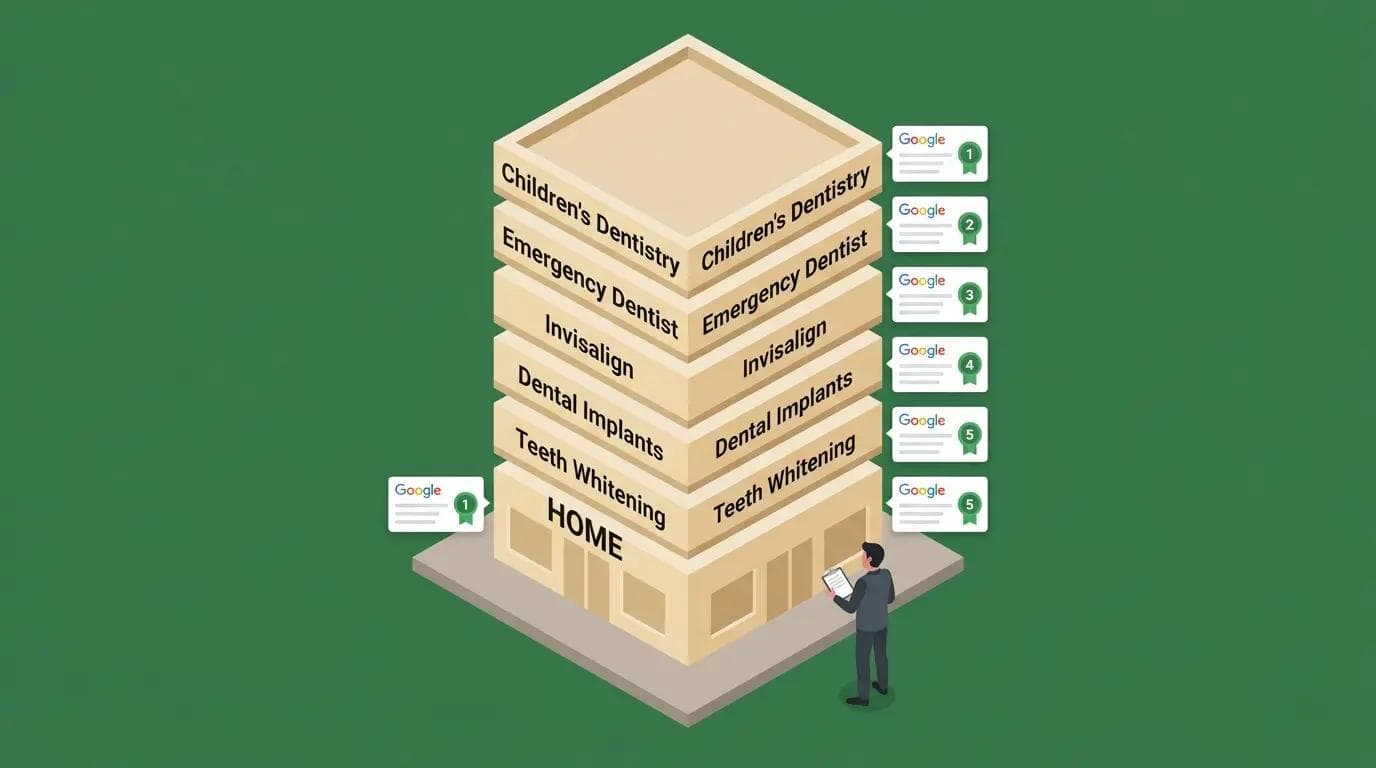
Search Engine Optimization layers
Paying for ads instead of fixing the organic foundation
Google Ads give you visibility while you pay and nothing when you stop. A dental practice spending $1,500 per month on ads for two years has spent $36,000 and built zero lasting search presence. That same investment in a properly built website and consistent SEO setup would have generated compounding organic visibility that does not stop when the budget does. Ads have their place but they should supplement organic search, not replace it.
Treating SEO as a one-time task
SEO is not a project you complete. It is an ongoing activity. Your competitors are adding content, collecting reviews, and updating their sites regularly. A dental practice that sets up its SEO once and never touches it again will see its rankings erode over time as competitors with more active sites pull ahead. The minimum ongoing commitment is posting to Google Business Profile twice a month, asking for reviews after every appointment, and updating service pages when treatments or prices change.
Ignoring Google Search Console data
Most dental practices either do not have Google Search Console set up or never look at it after initial setup. This is the equivalent of running a practice without ever reading your patient enquiry data. Search Console tells you exactly which searches your site is appearing for, which pages are performing, and which have technical problems. Checking it monthly and acting on what you find is one of the highest-return SEO activities available at zero cost.
How I Handle SEO Setup on Dental Websites
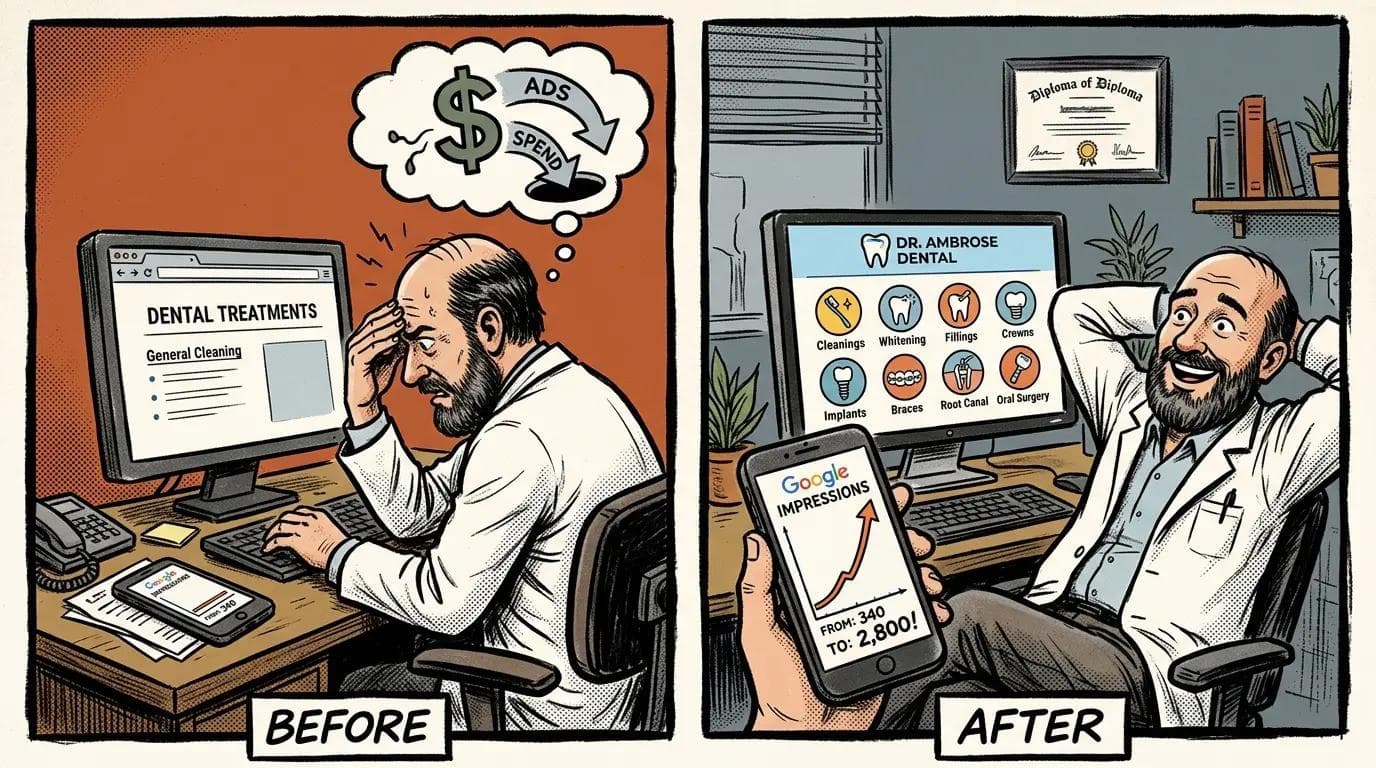
Website ranked after proper seo
Every dental website I build comes with the core SEO foundation configured before the site goes live. Google Business Profile connected and verified. Individual treatment pages built with location-specific content and proper page titles. An SEO plugin installed and configured with unique titles and meta descriptions for every page. Sitemap submitted to Google Search Console. Images compressed for mobile performance. Google Analytics connected.
This is not a separate SEO package. It is part of how I build every site. A dental practice that launches a new site with these foundations in place starts generating organic visibility from day one rather than spending months getting the technical basics right after launch.
I have built websites for service businesses across the UK, US, Canada, Australia, UAE, and Dubai. The local SEO principles are the same in every market: Google Business Profile, individual service pages, fast mobile load, and a steady stream of reviews. The specific execution varies by location and the competitive landscape of the local dental market.
Ready to stop paying for every patient click?
Send me your website for a free homepage audit. I will tell you which of the six SEO foundations your site is missing and what fixing them would realistically do for your local search visibility.
Do You Want This Handled for You?

Dental Appointements
The $449 web design package builds every one of these six SEO foundations into your dental website from day one. You do not need to configure them separately or hire an SEO agency on top of the design cost.
Google Business Profile connected. Individual treatment pages. Correct page titles and meta descriptions. Fast mobile load. Review display on the homepage. Sitemap submitted. All included in one fixed price.
View the $449 Web Design Package
About the Author
Sheikh Hassaan, Digital Architect for Small Businesses
I help service businesses launch fast, secure, conversion-focused websites without the agency price tag.
Related Articles
- Professional Website Design for Dentists (With Free Website Audit)
- Is It Worth Paying for a Website in 2026?
- HTML Website vs WordPress: Which Is Better for Small Business?
Frequently Asked Questions
How can dentists optimize their website design for SEO?
Dentists can optimize their website for SEO by setting up and completing their Google Business Profile, building individual pages for each treatment they offer, writing specific page titles and meta descriptions for every page, improving mobile load speed, collecting and displaying patient reviews, and submitting their sitemap to Google Search Console. These six steps cover the core of dental website SEO and can produce measurable improvements in local search visibility within 60 to 90 days.
Does SEO for dentists work without paying for ads?
Yes. A dental practice with a properly structured website, a fully configured Google Business Profile, and a steady flow of patient reviews can generate consistent organic patient enquiries without Google Ads. The timeline is longer than paid ads, typically two to four months to see meaningful movement, but the results are compounding and do not stop when the budget does.
How long does dental SEO take to show results?
Local SEO improvements for dental practices typically show measurable results in 60 to 90 days for practices in moderately competitive markets. Google Business Profile optimization and review collection can produce improvements faster, sometimes within 30 days. Individual treatment pages take longer to rank because Google needs to crawl, index, and assess them against existing pages for the same queries. Sustained effort over six months produces significant cumulative results.
Is Google Business Profile important for dental SEO?
Yes. Google Business Profile is the single most important element of local SEO for dental practices. It controls whether your practice appears in the Google Maps pack, which displays above the standard search results for location-based queries. A fully completed profile with photos, posts, and regular review responses consistently outranks less maintained profiles for the same local search queries.
What is the difference between dental SEO and paying for Google Ads?
Google Ads give you immediate visibility while you pay and zero visibility when you stop. SEO builds organic ranking that persists and compounds over time without ongoing payment per click. A dental practice that invests in SEO correctly will generate patient enquiries from Google indefinitely without ad spend. A practice that relies entirely on ads has no lasting search presence and pays for every single patient