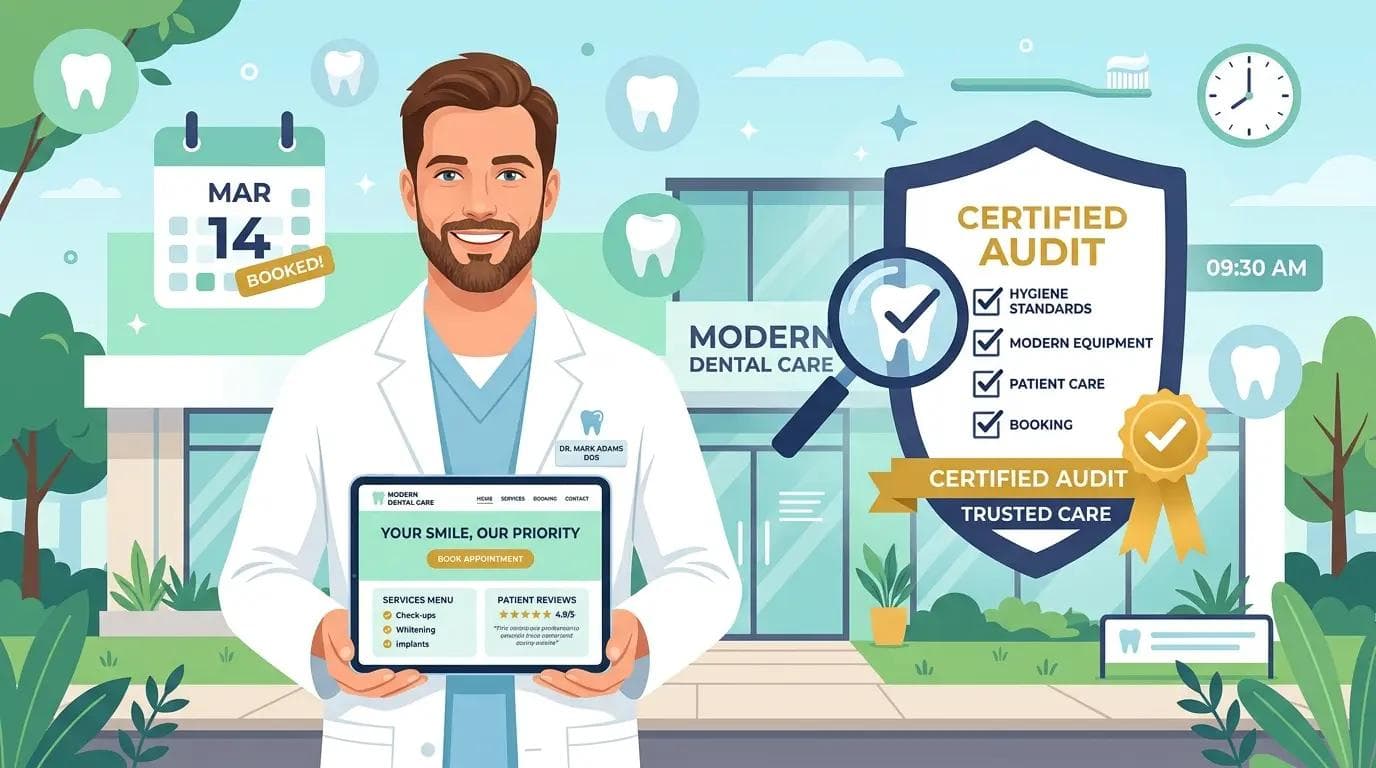
Dentist holding tablet showing professional dental website design with free website audit checklist for dental practice online presence.
Professional Website Design for Dentists (With Free Website Audit)
Website design for dentists that actually brings in new patients. What your dental site needs, what most get wrong, and a free audit to see where yours stands.
Most dental websites look professional but are not set up to turn a visitor into a booked appointment. Here is what actually needs to change.
By Sheikh Hassaan, digital architect for small businesses
Quick Answer
A good dental website needs a clear headline naming your location and services, a visible online booking or contact button, fast mobile load speed, a Google Business Profile connection, individual pages for each treatment, patient reviews displayed prominently, and a trust section showing your qualifications and team. Most dental sites have the pages but not the structure that converts a visitor into a booked patient.
Why Do Most Dental Websites Fail to Bring in New Patients?
A dentist in Sydney had a website that looked clean and professional. It had been built by a local agency three years earlier. The photos were good. The colours matched the practice branding. But in three years, the front desk team could not recall a single new patient who said they found the practice through the website. Every new patient came from referrals or the Google Maps listing.
The problem was not the design. The problem was that the website design for that dental practice had been built around what looked impressive rather than what a new patient needed to see to feel confident enough to book. There was no headline naming the suburb. The booking button was in the footer. The treatments page was one long list with no individual pages for each service. Google could not rank individual treatments because they had no dedicated pages.
This is the most common pattern in dental website design across the US, UK, Canada, and Australia. The site exists, looks acceptable, and does almost nothing for new patient acquisition. The Google Maps listing does the work the website should be doing.
Not sure if your dental website is actually working?
I offer a free homepage audit where I review your site and tell you:
1. What is stopping new patients from booking
2. What to fix immediately without spending anything
3. Whether your site needs small updates or a full rebuild
Send me your website URL on WhatsApp and I will review it for you.
What Does Good Website Design for a Dental Practice Include?
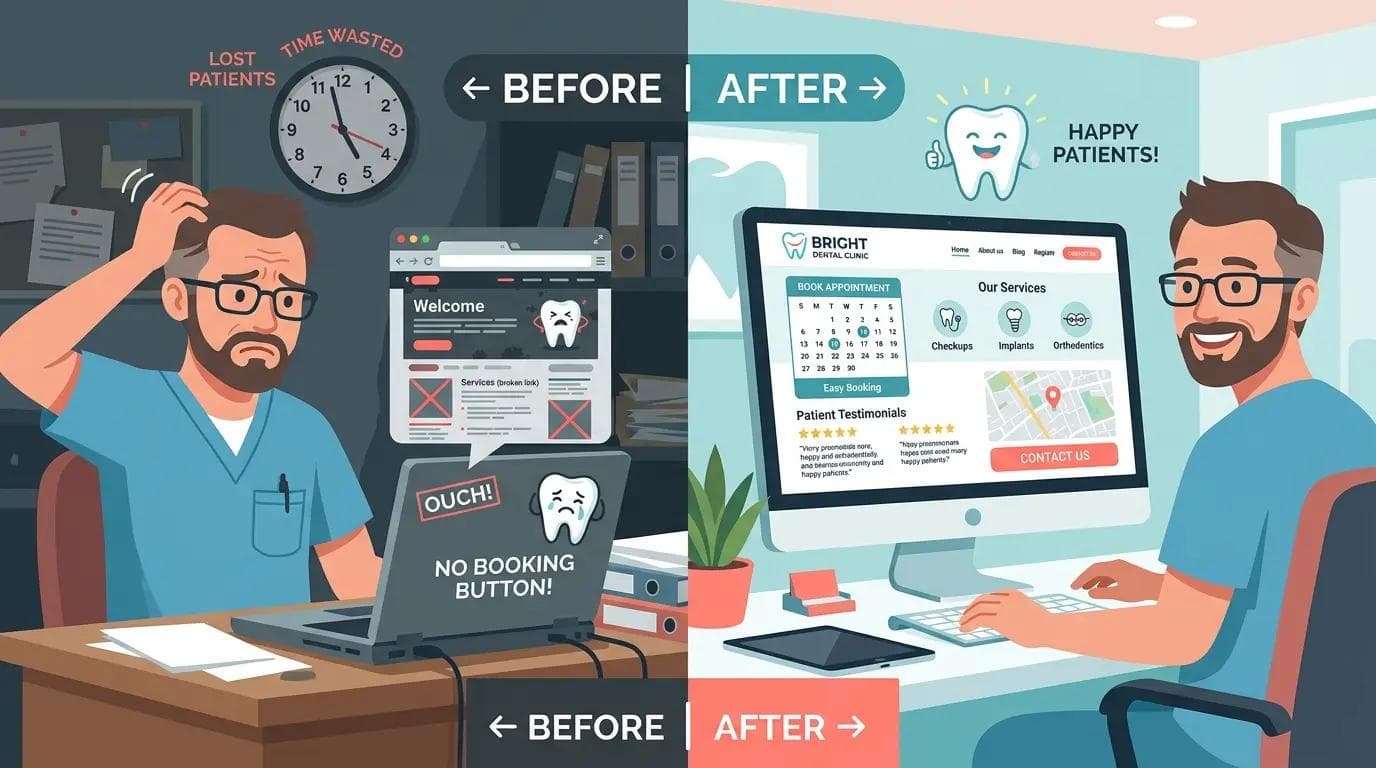
Before and after comparison of dentist website design
A dental website that generates new patient bookings is structured differently from one that just looks professional. Here is what each key page needs to do and why it matters for turning a visitor into a booked appointment.
The homepage
The homepage has one job: tell a new visitor immediately what practice they have found, where you are located, and what to do next. The headline should name your practice type and your location. Something like General and Cosmetic Dentist in Manchester or Family Dental Care in Melbourne is immediately useful to a visitor who found you through a local search. A practice name alone tells them nothing.
Below the headline, the most important element is a visible booking or contact button that does not require scrolling to find. On mobile, where more than 60 percent of dental website visits happen, this button needs to be accessible within the first screen. A phone number displayed prominently in the header is equally important because many patients, especially older ones, prefer to call rather than fill in a form.
Trust signals on the homepage matter more for dental practices than almost any other service business. A patient is making a decision about their health and their mouth. Patient reviews, accreditation badges, years of experience, and a photo of the actual team build the confidence that turns a browser into a caller. Generic stock photos of teeth or dental equipment do not build trust. A real photo of your actual team does.
The services pages
This is where most dental websites lose patients and rankings simultaneously. A single treatments page that lists every service in one long scroll is one of the most common and most costly mistakes in dental website design. Google cannot rank a page for a specific treatment if that treatment shares a page with twenty others. A patient searching teeth whitening near me or dental implants in Toronto needs to land on a page specifically about that treatment, not a general list.
Every main treatment your practice offers should have its own dedicated page. General dentistry, teeth whitening, dental implants, Invisalign, emergency dentistry, and children's dentistry are all separate search queries with separate patient intent. Each one deserves a page that answers the questions that patient is asking: what does it involve, how long does it take, what does it cost, and how do I book.
Include before and after photos on relevant treatment pages where you have them and permission to use them. For cosmetic treatments especially, visual proof of results is the single most persuasive element on the page. A patient considering veneers or teeth whitening wants to see real results from your practice, not stock photos.
The about page
Patients choose dentists the same way they choose any trusted professional: based on who the person is, not just what service they provide. The about page is where that trust gets built. Include a photo and short bio for each dentist and hygienist. Include your qualifications and the dental associations you belong to. If your practice has been serving the community for ten or twenty years, say so explicitly. These details matter to patients who are nervous about dental visits, which is a large proportion of your potential new patients.
For practices in the UK, include your GDC registration number. For Australian practices, include AHPRA registration. For US practices, include state licensing information. These signals tell a potential patient that you are verifiable and accountable, which reduces the trust barrier for someone booking with a new dentist for the first time.
The contact and booking page
The contact page for a dental practice needs to make booking as easy as possible on mobile. A short form with name, phone number, and preferred appointment type is enough. Do not ask for date of birth, insurance details, or dental history on the contact form. That information can be collected at the first appointment. Every additional field on a contact form reduces the number of people who complete it.
Include your practice address with a Google Maps embed, your phone number as a clickable link so mobile users can call with one tap, your opening hours, and if your practice uses an online booking system, a direct link to it. Patients who are ready to book at 10pm on a Sunday will book through an online system. If you do not have one, you lose that booking until the morning.
Does your dental website have individual pages for each treatment?
Send me your site on WhatsApp and I will tell you which pages are missing, what Google cannot rank you for, and what would make the biggest difference to new patient bookings.
If a rebuild makes more sense, professional dental websites start from $449, fast loading, Google-ready, and built to convert visitors into booked patients.
What Makes a Dental Website Different From a Generic Business Site?
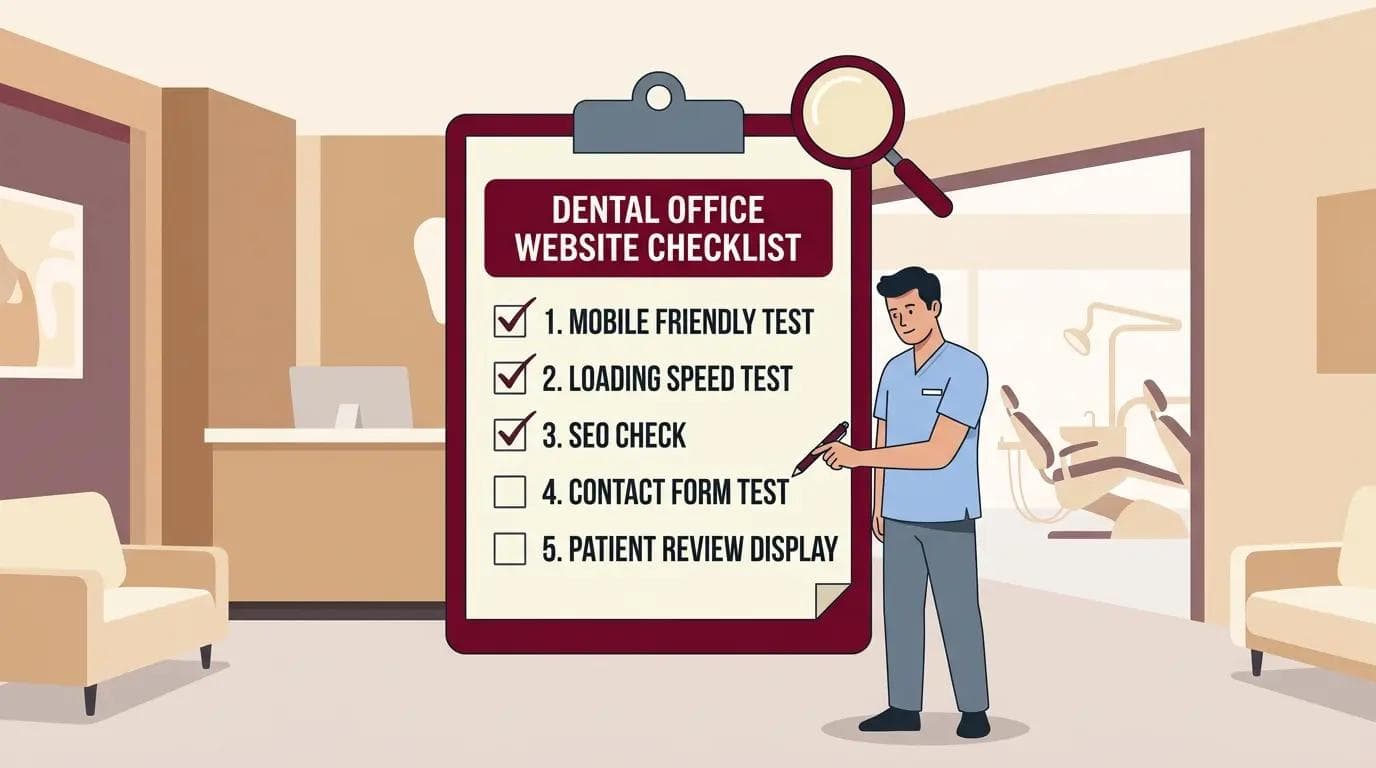
Before and after comparison of dentist website design
A dental practice website has specific requirements that a general service business site does not. Trust is higher stakes because patients are making decisions about their health. Local intent is stronger because nobody travels far for routine dental care. And the treatment-specific search queries are more varied and more numerous than most service businesses.
A dental website needs to rank for general searches like dentist near me and dentist in your city, but also for treatment-specific searches like dental implants cost in Melbourne or emergency dentist open Saturday in London. These are separate search queries with separate pages. A responsive dental website built correctly can rank for dozens of these queries simultaneously, creating a steady stream of new patient enquiries from multiple entry points.
Compliance and trust signals are also specific to dental practices. Patient testimonials are highly persuasive in this industry but need to comply with advertising guidelines in your region. In the UK, this means following GDC guidance on testimonials. In Australia, AHPRA advertising guidelines apply. A web designer building dental websites needs to understand these requirements or you take on compliance risk you may not be aware of.
How Much Does Website Design for a Dental Clinic Cost?
Website design for a dental practice cost between $449 for a fixed-price professional package and $8,000 or more for a large agency project. The right price depends on the size of the practice, the number of treatment pages needed, and whether you need custom features like online booking integration or patient portal access.
For a single-location dental practice that needs a clean, fast, properly structured website with individual treatment pages, a Google-connected setup, and a contact and booking flow that works on mobile, a $449 fixed-price package covers everything. The practice gets a professional site built for patient acquisition without the overhead of a dental-specialist agency.
Dental-specialist web design agencies typically charge $3,000 to $8,000 and market themselves as specialists in healthcare websites. Some of that premium reflects genuine experience with compliance and healthcare-specific UX. Some of it is simply the agency overhead of a niche-focused business. For a small or single-dentist practice, that premium rarely delivers proportional value over a well-built general professional site at a lower price.
What Are the Mistakes That Make Dental Websites Lose Patients?

Dental Clinic with booking system
One treatments page instead of individual pages for each service
A single treatments page with every service listed together is the biggest missed SEO opportunity in dental website design. Google cannot rank a page for dental implants if that page also covers general checkups, teeth whitening, and orthodontics. Each treatment a patient searches for needs its own page with its own content. Building individual treatment pages can multiply the number of Google searches your site appears for without adding a single link or spending on ads.
No visible booking action on mobile
More than 60 percent of dental website visits happen on mobile. A booking button or phone number that is buried in a menu or placed only at the bottom of the homepage is invisible to most visitors. A patient who cannot find how to contact you within the first few seconds of landing on your site will close the page and try the next result. Put your booking action in the mobile header and make it visible without scrolling.
Slow load speed on mobile networks
A dental website with large uncompressed images, heavy plugin overhead, or cheap shared hosting loads slowly on mobile. Studies across healthcare websites consistently show that a site taking more than three seconds to load loses more than half its visitors before the page is visible. Every image on a dental website should be compressed to under 200KB before upload. The site should score above 80 on Google PageSpeed mobile. Slow loading costs patient bookings every day it goes unfixed.
How I Build Websites for Dental Practices
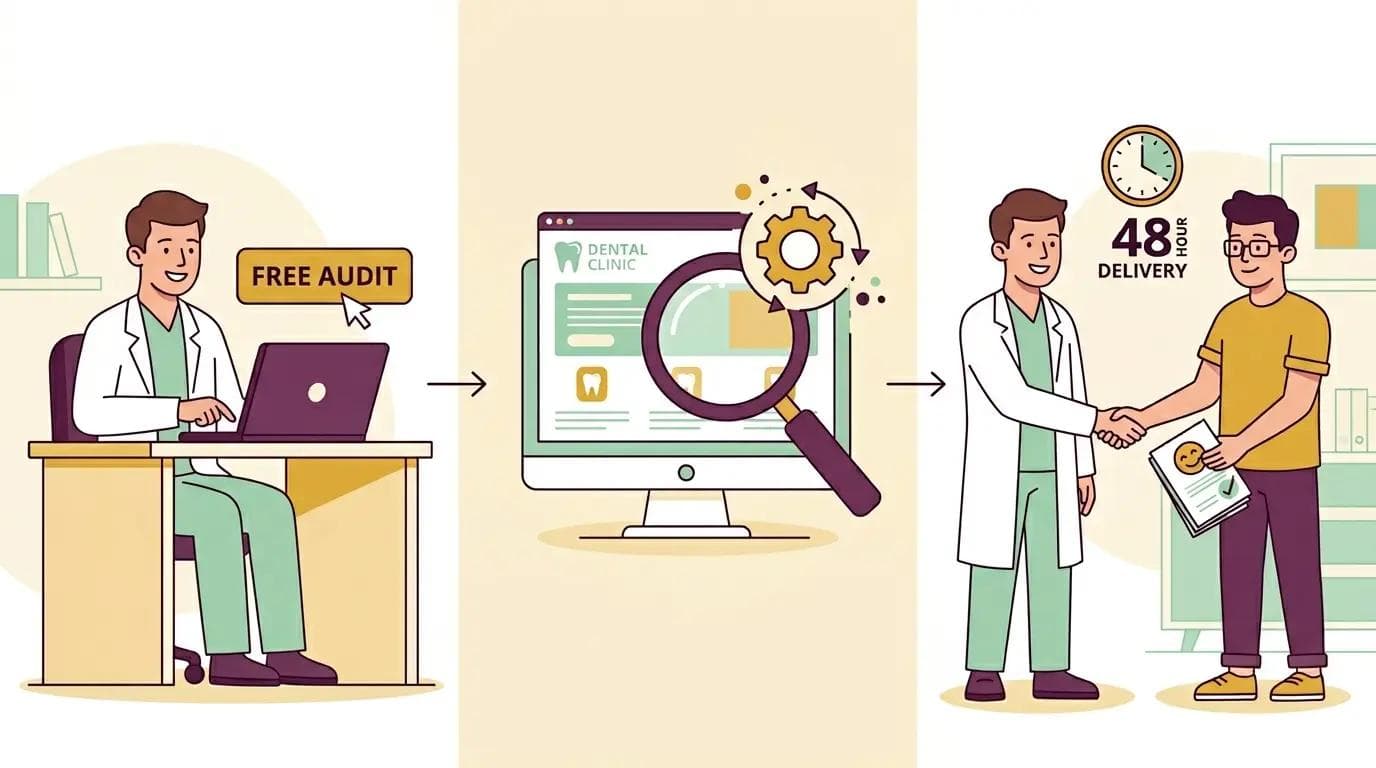
Three step process showing dentist claiming free website audit receiving analysis report and getting professional website design help.
Every dental website I build starts with a keyword research step before any design work begins. I identify the specific treatment searches your potential patients use in your city, map those to individual pages, and make sure each page is structured to rank for that specific query. This happens before a single pixel of design is created because structure drives results and design follows structure.
I build with WordPress or Next.js depending on the complexity of the project. Every dental site includes individual treatment pages with unique content, a homepage headline naming the practice location and type, a mobile-first contact flow with a visible booking button, Google Business Profile connected, patient reviews displayed on the homepage, fast mobile load with compressed images, SSL security, and daily backups.
I have built websites for healthcare and service businesses across the UK, US, Canada, Australia, UAE, and Dubai. The principles are the same regardless of location: structure for search, design for trust, build for mobile, and make booking as frictionless as possible.
Want to know exactly what your dental website is missing?
Send me your site on WhatsApp for a free homepage audit. I will check your treatment pages, your mobile booking flow, your Google setup, and your load speed, and tell you what is costing you new patient bookings right now.
If a rebuild or new site makes more sense, professional dental websites start from $449, individual treatment pages, fast mobile load, Google setup, and full ownership from day one.
Do You Want This Handled for You?
The $449 web design package is for dental practices that want a properly built site without the agency price tag. Individual treatment pages. Homepage built for local search. Mobile booking flow. Google Business Profile connected. Patient reviews displayed. Fast load speed. Full ownership from day one.
Built by someone who understands how patients find and choose a dentist online, not just how to make a site look professional.
View the $449 Web Design Package
About the Author
Sheikh Hassaan, Digital Architect for Small Businesses
I help service businesses launch fast, secure, conversion-focused websites without the agency price tag.
Related Articles
- Is It Worth Paying for a Website in 2026?
- HTML Website vs WordPress: Which Is Better for Small Business?
- Which is Best Website Builder vs Professional Designer?
Frequently Asked Questions
What does a good dental website need to include?
A good dental website needs a homepage headline naming your location and practice type, a visible booking or phone button on mobile, individual pages for each main treatment, patient reviews displayed prominently, a Google Business Profile connection, fast mobile load speed, and a short contact form that does not ask for unnecessary information. These elements together convert visitors into booked patients rather than just building an online presence.
How much does website design for a dentist cost?
Website design for a dental practice costs between $449 for a fixed-price professional package and $8,000 or more for a specialist dental agency. For a single-location practice that needs a clean, properly structured site with individual treatment pages and a Google-ready setup, a $449 package covers everything needed to generate new patient enquiries without agency overhead.
Why does my dental website not bring in new patients?
The most common reasons a dental website fails to generate new patients are: no individual pages for each treatment so Google cannot rank for specific searches, no visible booking action on mobile, slow load speed that loses visitors before the page loads, and no Google Business Profile properly connected to the site. These are fixable problems. A free homepage audit can identify exactly which ones apply to your site.
Do dentists need a responsive website?
Yes. More than 60 percent of dental website visits happen on mobile devices. A responsive dental website adapts correctly to all screen sizes, keeps the booking button visible without scrolling, and loads fast on mobile networks. A site that does not work properly on a phone is losing more than half its potential new patient enquiries before those patients ever see your content.
What is the difference between a dental website agency and an independent web designer?
A dental website agency typically charges $3,000 to $8,000 and markets specifically to healthcare practices. An experienced independent web designer charges less because their overhead is lower, not because the work is less skilled. For a single-location dental practice, an independent designer who builds patient-focused sites with proper SEO structure and mobile performance often delivers equivalent results at a fraction of the agency price.