Businesses with websites
Which is Best Website Builder vs Professional Designer?
Website builder vs professional designer: honest comparison from someone who has seen both sides. Find out which one actually works for small businesses.
Both options can work. The problem is most people pick based on price and end up choosing wrong.
By Sheikh Hassaan, digital architect for small businesses
Quick Answer
A website builder is the right choice if you only need a basic online presence, have time to build it yourself, and do not need the site to generate leads from Google. Hiring a professional designer is the right choice if you need the site to bring in clients, rank in search results, or represent your business to people who will judge your credibility by what they see.
Why Does This Choice Feel So Difficult to Make?
The website builder vs professional designer question comes up constantly because the marketing from both sides is misleading. Website builder ads show polished professional results that took a skilled designer hours to produce. Web design agency ads show prices that make a small business owner feel like they need to take out a loan. Neither represents what most people actually experience.
A coach in the US spent four months on a website builder trying to get something that looked as good as the examples in the ads. She eventually paid $1,200 to a designer to rebuild it from scratch. The total cost was higher than if she had hired someone to start with, and she lost four months of professional online presence in the process.
The right answer is not one size fits all. It depends on what you need the site to do, how much of your own time you are willing to spend, and what outcome you are actually trying to achieve.
Website Builder vs Professional Designer: What Each Option Actually Delivers
Here is an honest look at what each option gives you and where each one falls short, based on working with both approaches across many projects.
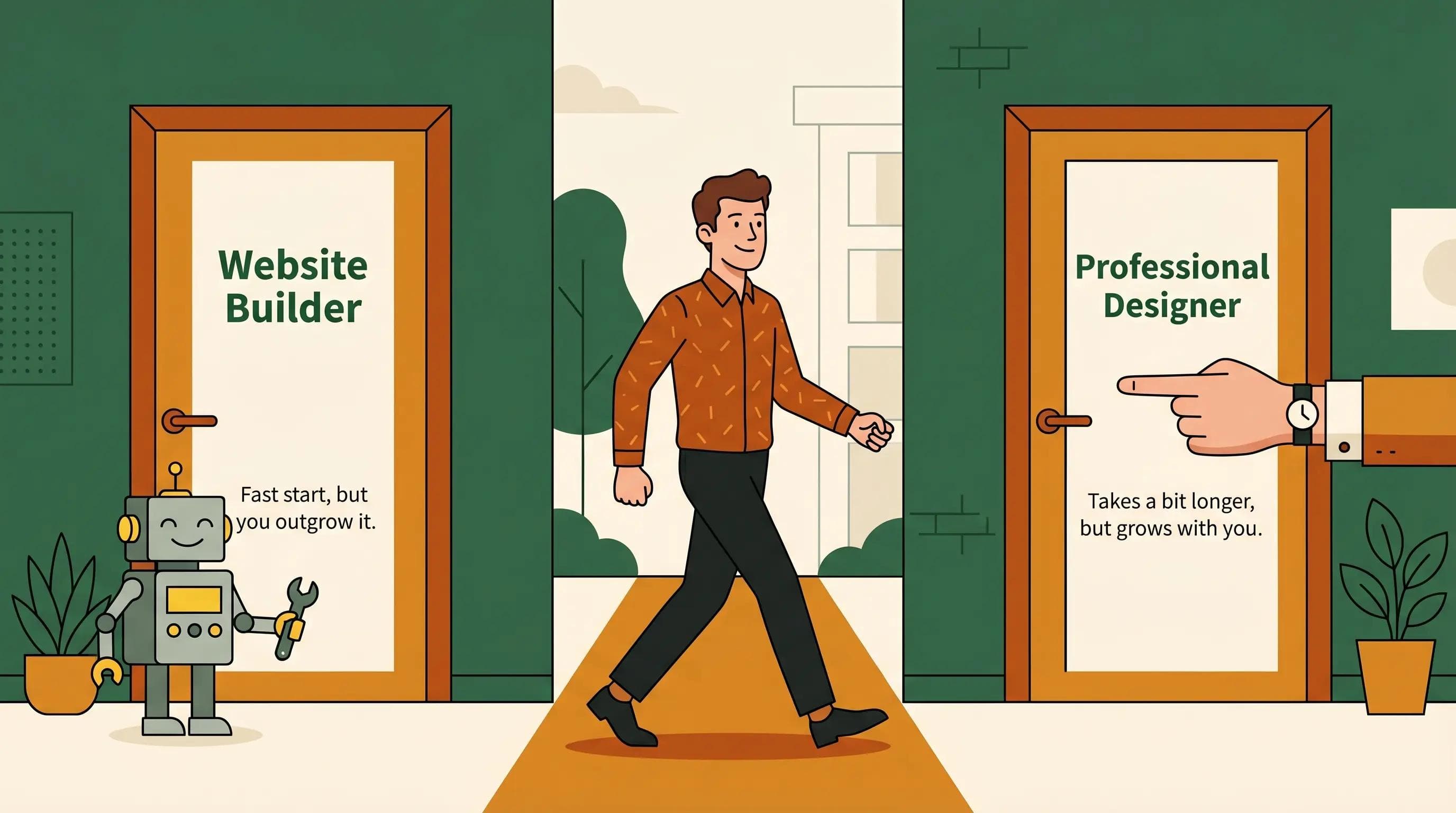
Choosing between website builder and professional designer
What a website builder gives you
A website builder gives you control, speed, and a low upfront cost. You can have something live in an afternoon. You can update your own content any time without asking anyone for help. For a business owner who enjoys this kind of project and does not need the site to rank on Google or convert strangers, a builder can be exactly right.
The trade-offs are real and worth knowing upfront. Website builders host your site on their platform. You do not own the infrastructure. If the company changes its pricing or shuts down, your site is affected. The templates look similar to thousands of other sites on the same platform. And the features that matter most for lead generation, proper SEO setup, custom contact flows, WhatsApp integration, Google Business Profile connection, usually require workarounds or are simply not available.
The monthly fee is also not the total cost. Over two years, a mid-tier website builder subscription with a custom domain adds up to $500 to $1,000 before you count the hours you spend on it. That comparison matters when you are evaluating the true cost difference between a builder and hiring someone.
Real example: A tradesperson in Australia used a free website builder for two years. His site looked dated, was slow on mobile, and had generated maybe three enquiries in 24 months. He paid $449 for a properly built site. In the first month he received seven enquiries. The two-year cost of free had been very expensive in lost work.
What a professional designer gives you
A professional designer gives you a site built around your business rather than a template. The headline speaks to your client type. The contact flow is built around how your clients prefer to get in touch. The performance is optimised for how your clients actually browse, which for most service businesses is on a phone. These things do not happen by accident in a well-built site.
The cost gap between a builder and a designer is smaller than most people think when you account for the full picture. A $449 fixed-price professional build versus $30 per month on a builder for two years. The difference in cost over two years is minimal. The difference in results is often large.
The main trade-off with hiring someone is that you are dependent on them for changes unless the site is built on a platform you can manage yourself. A good designer builds on a system you can update, hands over full ownership, and leaves you in control from day one. A bad designer builds something that requires paid support for every small change.
The difference between these two options is not really about price. It is about who the site is built for. A builder produces a site built for anyone. A designer produces a site built for your clients.
When Is a Website Builder the Right Choice?
A builder is the right choice when you have a personal project, a hobby business, or a side venture where the site just needs to exist rather than generate leads. If you are testing a business idea before investing in a proper setup, a builder gives you something visible quickly at low cost.
A builder also works if you genuinely enjoy building and maintaining a site and are willing to invest the time it requires. Some business owners find it satisfying and develop genuine skill with their chosen platform. For those people, a builder can produce good results over time.
Use a builder if your budget is genuinely zero right now and you need something online while you save up for a proper site. A basic presence is better than no presence, with the understanding that it is a placeholder rather than a growth tool.
When Does Hiring a Designer Make More Sense?
Hire a designer when the site needs to generate enquiries from Google, from social media, or from direct visits by people who have heard about your business and want to check you out before getting in touch. These visitors are making a trust decision. What they see on your site determines whether they contact you or move on.
Hire a designer when your time has real value and spending 20 to 40 hours on a website build represents a meaningful cost in lost client work or personal time. At a certain point, the math of DIY simply does not work in your favour.
Hire a designer when you have already tried a builder and the site is not working. A site that generates no leads after six months is not a site problem. It is a strategy problem. A designer can diagnose and fix the underlying issue in ways that template customisation cannot.
What Are the Mistakes That Make This Decision Cost More Than It Should?
Choosing a builder to save money and spending more time than it saves
The monthly fee of a website builder looks cheap. The time cost does not appear on the invoice. A service business owner who spends 40 hours building their own site is spending time that could have generated far more in client revenue than the cost of hiring someone. Always calculate time cost alongside money cost before choosing the DIY route.
Hiring a designer without checking their actual work
Not all professional designers produce professional results. Some charge professional prices for template installations that are no better than what you would get from a builder. Always ask to see three live sites the designer has built recently. Open them on your phone and check that they load fast and look properly designed. A portfolio PDF of mockups is not evidence of real work.
Treating the website as done once it is built
Both a builder site and a professionally built site need regular attention to stay visible in search results. New content, updated testimonials, current service descriptions, and fresh blog articles all signal to Google that the business is active. A site with no updates for 12 months starts to lose rankings regardless of how well it was built. Building the site is the start, not the finish.
How I Handle This on Real Client Projects
When a new client comes to me, the first thing I do is look at what they currently have and what they actually need. Some clients come with a builder site that is mostly fine and needs two or three specific improvements. Others have a builder site that is fundamentally the wrong tool for what they are trying to achieve and need a clean rebuild. I tell them honestly which one applies.
I build with WordPress, Next.js, or React depending on the project. Every build includes a clear headline written for the client type, a contact flow tested on a real phone, Google setup, security configured before launch, and full ownership handed to the client from day one. The site is built to be updated without needing to call me for every small change.
I have worked with clients who came from Wix, Squarespace, Weebly, and various other builders. The most common issue is not the design. It is that the site was built around what the business owner wanted to say rather than around what the client needs to hear to feel confident enough to get in touch.
Do You Want This Handled for You?
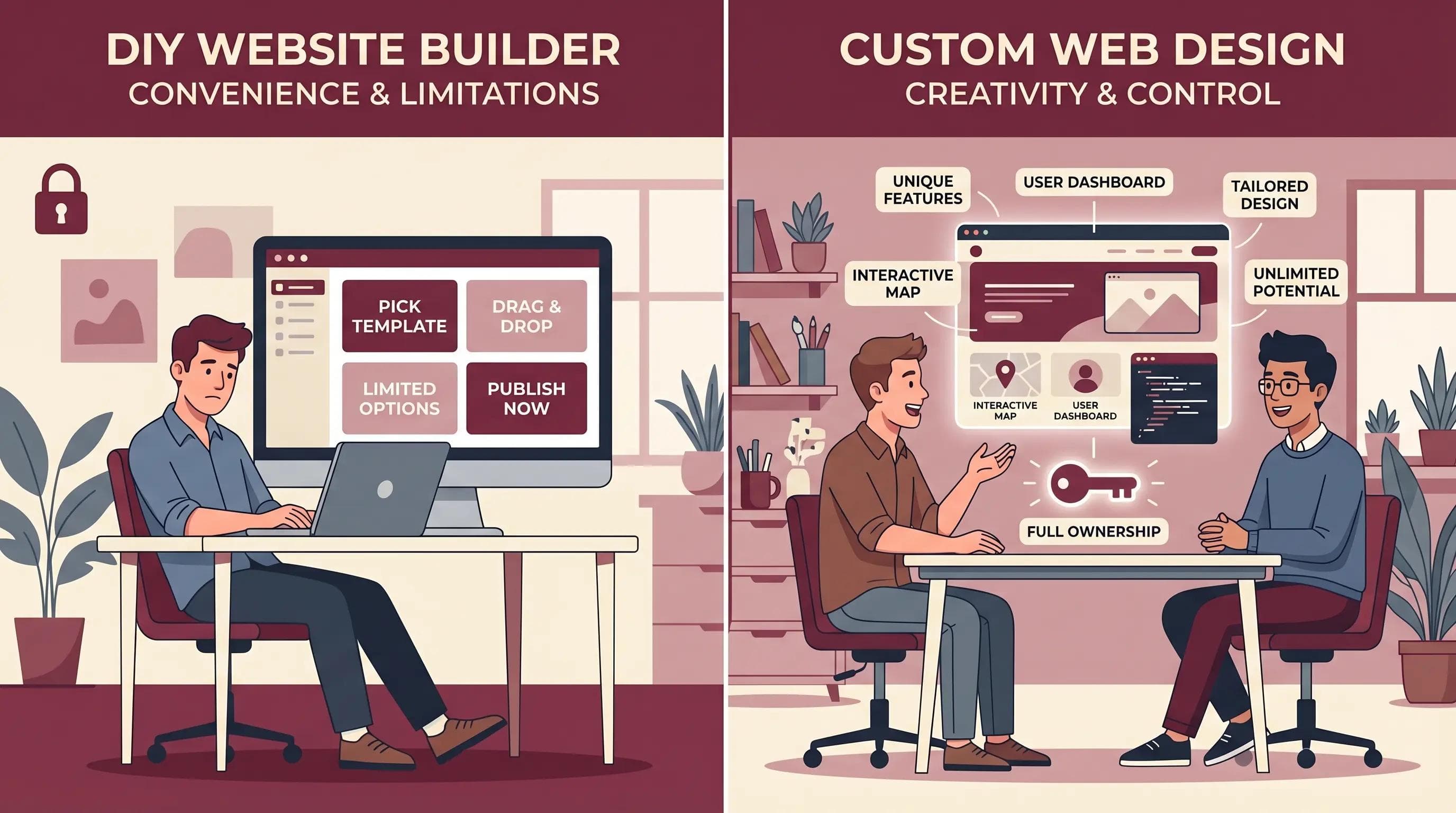
Trade off between easy but limited website builders and more control with a professional designer
The $449 web design package is for small business owners who have decided that a properly built site is the right investment for where they are right now. Not a template. Not a builder. A site built around your business, your clients, and the outcome you want it to deliver.
Five to seven pages. Fast mobile load. Google setup. Clear contact flow. Full ownership from day one. Delivered in 7 to 14 days.
View the $449 Web Design Package
About the Author
Sheikh Hassaan, Digital Architect for Small Businesses
I help service businesses launch fast, secure, conversion-focused websites without the agency price tag.
Related Articles
- How Long Does It Take to Build a Website? A Developer’s Honest Answer
- Should I Hire Someone to Build My Website or DIY?
- Rebuild My Website or Fix it?
Frequently Asked Questions
Is a website builder or a professional designer better for a small business?
A professional designer is better for a small business that needs its site to generate leads, rank on Google, or make a strong first impression on potential clients. A website builder is better for a business that just needs a basic online presence and has time to build and manage it. The right choice depends on what outcome you actually need from the site.
Website Builder vs Professional Designer: Pros and Cons
Website Builder Pros
- Low upfront cost and quick setup
- No coding required
- Full control over edits and updates
- Ideal for simple websites or early-stage businesses
Website Builder Cons
- Limited customization and flexibility
- Generic templates used by thousands of sites
- Weak SEO and lead generation capabilities
- Time-consuming if you want a polished result
Professional Designer Pros
- Custom design tailored to your business and audience
- Built for conversions, not just appearance
- Better performance, SEO setup, and mobile experience
- Saves you time so you can focus on your business
Professional Designer Cons
- Higher upfront cost
- May depend on the designer for updates (if not built properly)
- Requires choosing the right professional carefully
Website Builder vs Professional Designer Cost
A website builder usually costs between $15 to $40 per month plus domain fees. Over two years, that becomes $360 to $960, not including your time.
A professional designer typically charges a one-time fee. In many cases, a solid small business website can be built for around $400 to $1,500 depending on scope.
The key difference is not just price.
It is what you get in return.
A builder costs less upfront but more in time and missed opportunities.
A designer costs more upfront but is built to generate results.
What Is the Difference Between a Website Designer and a Website Builder?
A website builder is a tool.
A website designer is a person.
A builder gives you templates, drag-and-drop features, and basic functionality. It assumes you know what you are doing.
A designer brings strategy. They decide:
- What your headline should say
- How users move through your site
- Where to place contact points
- How to turn visitors into enquiries
The real difference is not technical.
It is thinking vs tools.
What Is the 3 Second Rule in Web Design?
The 3 second rule means this:
When someone lands on your website, they should understand what you do, who it’s for, and what to do next within 3 seconds.
If they cannot, they leave.
A strong website immediately answers:
- What is this business?
- Is this for me?
- What should I do next?
Most websites fail not because they look bad, but because they are unclear.
What Are the 7 C’s of a Website?
The 7 C’s are a simple framework for evaluating website quality:
- Context – Overall design and layout
- Content – The information and messaging
- Community – Interaction with users (comments, engagement)
- Customization – Personalization for users
- Communication – How users contact you
- Connection – Links to other platforms or services
- Commerce – Ability to sell or generate leads
Most small business websites only get 2 or 3 of these right.
The ones that perform well get at least 5 right.
Which Is Better: A Web Designer or a Web Developer?
They solve different problems.
A web designer focuses on:
- Layout, user experience, and visual structure
- Messaging and conversion flow
- How the site feels to a visitor
A web developer focuses on:
- Code, functionality, and performance
- Building features and integrations
- Making the site technically work
If your goal is leads and credibility, a designer is usually the priority.
If your goal is complex functionality, you need a developer.
Should I switch from a website builder to a professional designer?
Switch from a website builder to a professional designer if your current site is not generating enquiries after six months, if your mobile PageSpeed score is below 70, if you are spending significant time managing the builder platform, or if clients are mentioning that your site looks dated. These are signs that the builder has reached its limit for your business needs.
Should You Use a Website Builder or Hire a Professional Designer for a Small Business Site?
When deciding between a website builder and a professional designer, it comes down to your goals, budget, and how important your website is for getting clients. A website builder can be enough if you only need a simple online presence, want something quick to set up, and are comfortable managing everything yourself. However, it often comes with limits in design flexibility, SEO strength, and long-term growth potential. A professional designer, on the other hand, builds the website around your business goals, focusing on user experience, conversions, and search visibility, which makes it a stronger choice for businesses that rely on their website to generate leads and build trust.
Is a DIY Website Platform Enough for a Small Business?
A DIY website platform can work for early-stage businesses, personal projects, or situations where the main goal is simply to exist online. It allows you to get a site live quickly without technical skills. However, for businesses that depend on enquiries, bookings, or sales, a DIY platform often falls short because it usually lacks proper conversion structure, advanced SEO setup, and strategic design decisions that guide visitors toward taking action.
What Are the Cost Differences Between Website Builders and Professional Web Design?
Website builders usually have low monthly costs, typically ranging from basic plans to premium subscriptions, but these add up over time and also require your own time investment to build and maintain the site. Professional web design services usually involve a one-time upfront cost, but they deliver a complete, structured website built for performance, branding, and lead generation. While the initial price is higher, the long-term value often comes from better results rather than just lower maintenance effort.