Small Business Website Packages
Most local business owners do not need a six-month agency project to establish an online presence. What you need are professional small business website packages that deliver a high-quality site quickly, with clear, fixed pricing and no ongoing agency bloat. These website packages for small business are designed to help plumbers, clinics, consultants, and local shops launch a credible online presence without the headache.
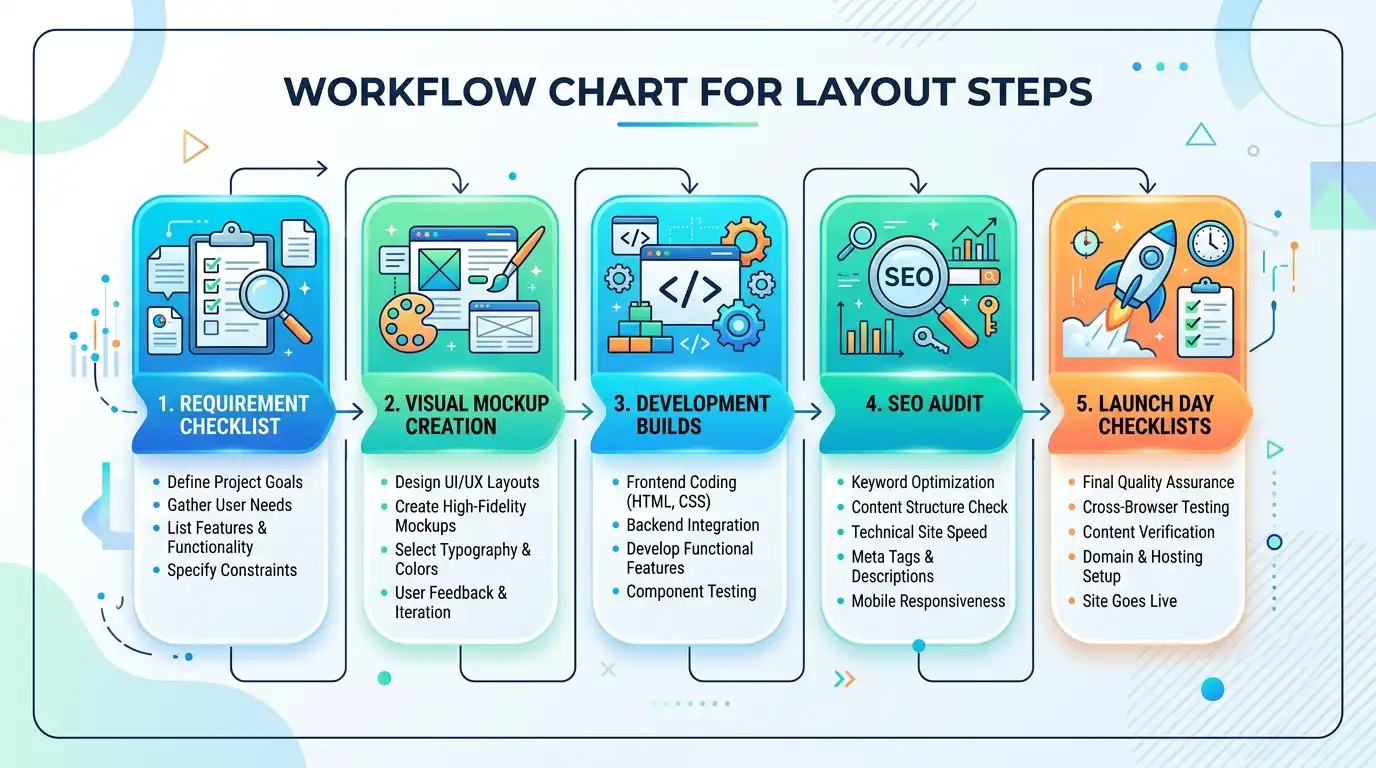
Whether you need a simple five-page setup or a robust ten-page site with a booking system, these small business website design packages cover everything from mobile-responsive layouts to complete setup of Google Analytics and baseline SEO. Every project includes fast 8-to-12-day delivery, direct communication with your designer, and 100% account ownership upon launch.
Below, you will find a side-by-side comparison of our Standard and Premium packages, followed by their exact pricing, so you can decide which option matches your budget and business goals within minutes. Ready to start your project or ask a question? Click below to jump straight to our packages or get in touch.
These packages reflect hands-on experience building and launching sites for healthcare clinics, property developers, and marketing agencies across the UK and US. That work spans more than two years of professional web design, including remote work for a US-based firm building production-level applications.
With a consistent five-star rating across freelance platforms, the workflow is built entirely around direct communication and honest, production-grade quality. You work directly with the developer executing the project—no salespeople, account managers, or layers of agency overhead to delay progress.
Compare Our Website Packages & Pricing
Review the features, timelines, and pricing of our Standard and Premium options to see which package aligns with your current business goals.
| Feature | Standard Package | Premium Package |
|---|---|---|
| Price | $369 (One-time) | $1,649 (One-time) |
| Best For | Service trades, local consultants, clinics | Growing businesses, retail, booking focus |
| Pages | Up to 5 pages | Up to 10+ pages |
| Delivery | 8 to 12 days | 4 weeks |
| SEO | Basic On-Page Optimization | Advanced SEO & Speed Tuning |
| Analytics | Google Analytics Setup | Google Analytics Setup |
| CMS / Blog | No (Static layout) | Yes (Sanity CMS Integration) |
| Booking System | Optional Add-on | Yes (Custom booking setup) |
| Ecommerce | No | Yes (Up to 20 products) |
| Ownership | 100% Client-Owned | 100% Client-Owned |
| Support | Launch support | Walkthrough session & 30-day support |
| CTA | Select Standard | Select Premium |
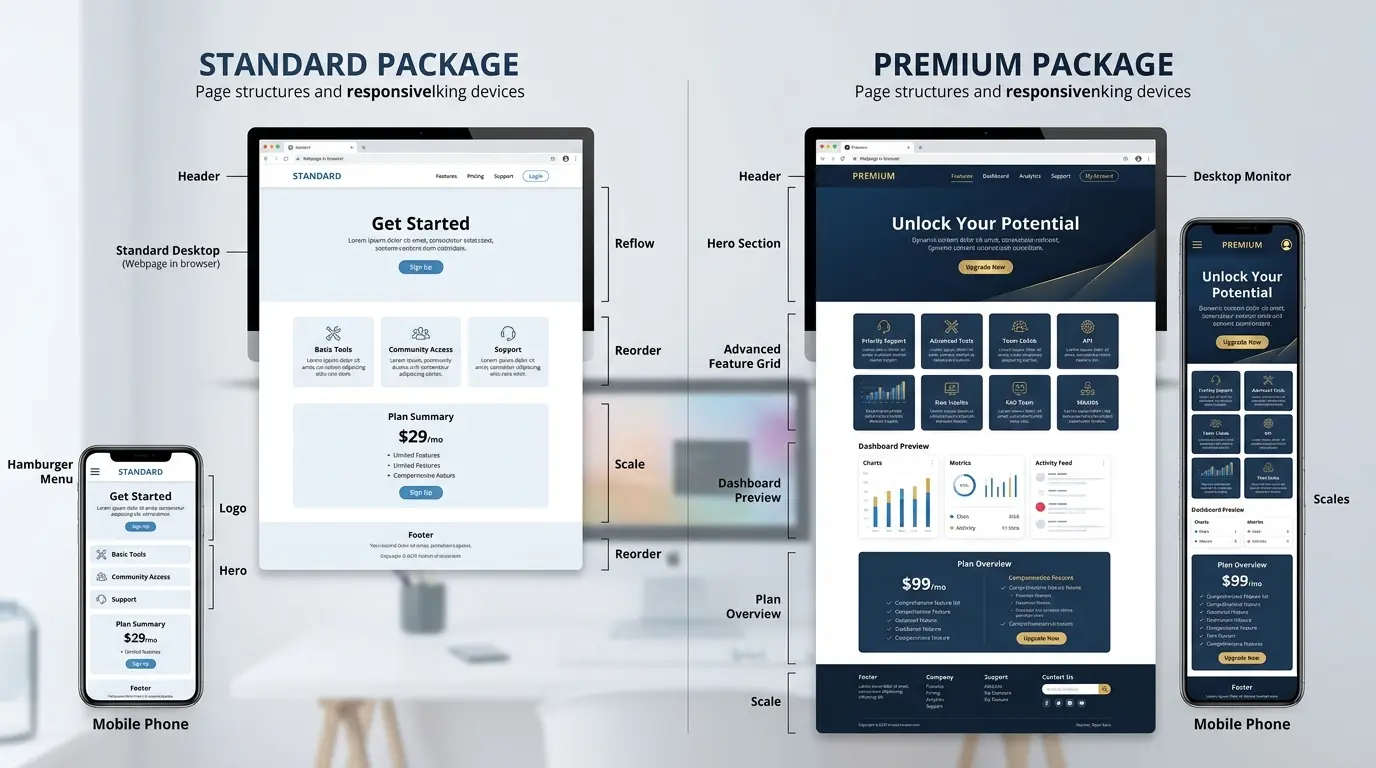
Standard
Perfect for local services & small businesses
Everything Included
Premium
For growing businesses needing CMS or store
Everything in Standard, Plus
Still Unsure Which Package is Right for You?
Book a brief consultation to share your details. I'll provide an honest, no-pressure assessment of exactly which package aligns with your business goals.
Why Choose These Small Business Website Packages
Selecting a website package should be simple. These offerings are designed around transparency, fast delivery, and clean development, removing the hidden retainers and surprise billing commonly associated with design agencies.
Fixed Pricing, No Hidden Fees
The price quoted is the price you pay. There are no surprise configuration fees, setup charges, or monthly platform lock-ins. You pay once and own your assets outright.
On-Page SEO Included
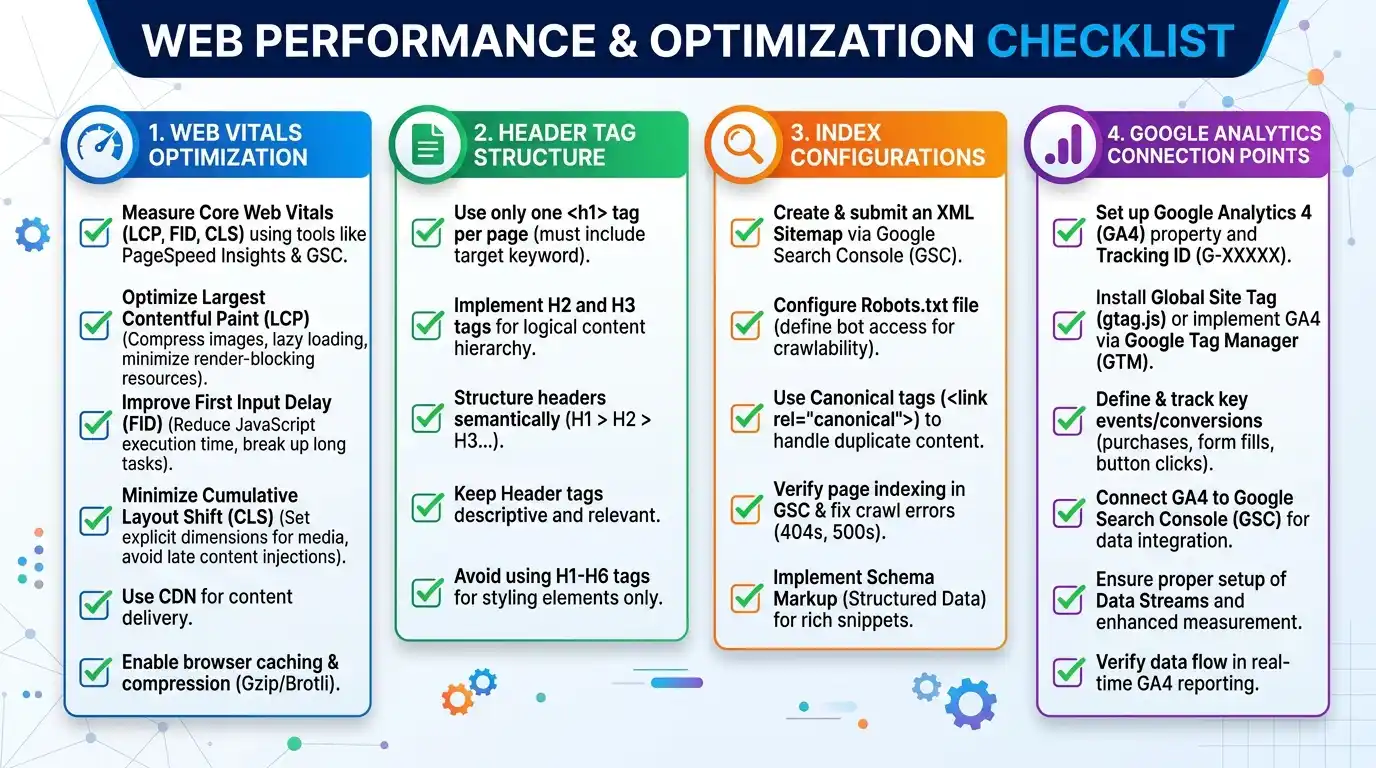
Search engine readiness is not treated as a paid upsell. Baseline SEO—including page titles, meta descriptions, and clean heading structures—is implemented as standard on every page.
Responsive & Device Tested
Your site is configured to load and format correctly on actual physical devices, ensuring that mobile visitors face no hard-to-tap buttons or layout errors.
100% Client Ownership
At final delivery, you receive administrative logins for your hosting and domain registrar. Nothing is held hostage under a developer-controlled account.
Direct Freelancer Communication
You speak directly with the designer executing the build. Revisions are communicated in daily batches, skipping agency telephone tag and project manager queues.
Fast, Structured Delivery
Standard pages are delivered in 8 to 12 days once content is ready. We work with a highly organized onboarding workflow that keeps timelines predictable.
Small Business Website Design Packages
Design-focused packages are built around one goal: a site that looks credible the moment someone lands on it and is easy for them to act on. Every tier below includes a mobile responsive build, a tested contact form, basic on-page SEO, and analytics connected from day one. What changes between tiers is the page count, how much custom design work goes into the layout and branding, and whether features like a blog, CMS, or e-commerce are included. The goal at every tier is the same regardless of budget: a site that turns visitors into enquiries rather than one that simply exists online.
What separates a good design package from a template dump
A lot of cheap website offers are really just a stock theme with your logo dropped in. The packages below are built by hand for the business they are for, even at the Standard tier. That means real copywriting structure, image optimization for fast load times, and a layout that matches how your specific customers actually make a decision to contact you.
Who each tier is actually built for
The Standard package fits a single-location service business that needs a clean, credible site fast: a consultant, a clinic, a tradesperson, or a small studio that mainly needs people to find them and get in touch. The Premium package fits a business that is actively marketing itself, publishing content, running seasonal offers, selling products online, or taking bookings directly through the site, and needs a CMS, e-commerce, or a booking system to manage that without calling a developer every time.
Neither tier is built to be outgrown immediately. Each one includes enough headroom that a business can operate on it for a year or more before needing to move up, which is part of why the feature list above matters more than the price tag on its own.
What this looks like by industry
An osteopathy or healthcare clinic typically needs clear service pages, a visible address and map, and a booking or contact path that does not make a patient hunt for the phone number. A property or real estate business needs image-heavy listing pages that load fast despite large photos, along with a structure that can grow as new listings are added. A marketing agency or consultant usually needs a portfolio or case study section that can be updated regularly, which is why that feature sits at the Premium tier rather than the Standard one. The right package depends less on your industry label and more on which of these patterns matches how your customers actually find and contact you.
Working with international clients
Client expectations are not identical everywhere, but a few things matter regardless of location. A working contact form, clear pricing, and fast load times are the baseline every client expects today, with messaging apps like WhatsApp increasingly treated as a primary contact method rather than a nice extra. Every package above includes WhatsApp integration as standard for exactly this reason, rather than treating it as an add-on that only some clients receive.
Time zones matter more than most owners expect too. A client and a developer working similar hours can turn a revision round around the same day, while a larger time difference simply means planning feedback in daily batches rather than real time. Neither setup is a problem on its own, but it is worth asking about expected response times across time zones before the project starts, especially if your team is spread across more than one region.
Payment and currency expectations also differ by client. Some are comfortable paying a fixed price upfront or in two milestone payments, while others prefer the option to pay in their local currency even when the headline price is quoted in USD, which is worth confirming with your provider before the invoice stage rather than after. None of this changes what is included in the package itself, but getting payment logistics agreed early avoids a delay right before launch.
What "mobile responsive" should actually mean
Mobile responsive is one of the most overused phrases in web design, and it gets applied to sites that technically resize on a small screen but are still hard to use on one. A properly responsive build means buttons and forms are large enough to tap accurately, text is readable without zooming, images load quickly on a mobile connection, and the contact form has actually been tested on a real phone rather than just a browser preview set to mobile width. Since most small business website traffic now arrives on a phone, this is not a nice-to-have feature, it is the primary version of the site for most visitors.
What Makes a Good Website Package?
When evaluating a website package, it is easy to focus entirely on the page count. However, the technical foundation of the page dictates whether it operates as a marketing asset or a liability. Ensure any package you buy includes:
Complete Hosting & Account Ownership
You must hold the primary billing account for the domain registrar and hosting. This guarantees that your site cannot be taken offline or ransom-charged by a designer.
On-Page SEO Architecture
A professional setup uses valid HTML headings, customizable Meta Tags, structured sitemaps, and optimized search engine formatting.
Page Speed & Asset Optimization
Large, uncompressed graphics slow down loading times, which can damage conversions. Images should be converted to modern formats (.webp) and code must remain clean.
Secure Forms & Data Processing
Contact forms require server-side spam prevention and secure email transport settings (SPF/DKIM) to prevent inquiries from landing in your spam folder.
Who These Packages Are For
These website packages are specifically optimized for local service providers, professional consultants, and brick-and-mortar businesses that depend on local search traffic and direct client inquiries.
Trades & Construction
Built for plumbers, electricians, roofers, and general contractors who need fast mobile access, clear project portfolios, and simple tap-to-call links.
Professional Services
Designed for law firms, consultants, business coaches, and local agencies who require authority-building copy, service breakdowns, and booking pathways.
Health & Wellness
Tailored for osteopaths, dental clinics, medical offices, and fitness coaches needing location mappings, credentials display, and booking software connections.
Real Estate & Property
Configured with media galleries, Google Maps integrations, and modular pages that accommodate listing properties without affecting site speeds.
Restaurants & Hospitality
Includes menu display sections, business hours, reservation links, and Google Business Profile connection hooks for local restaurant queries.
Independent Retail
Perfect for local boutiques and craft brands ready to list up to 20 signature products with secure payment processing through Stripe or PayPal.
What's Included That Others Charge Extra For
It is common to receive a low initial quote, only to discover that the essentials required to make a site operational are treated as paid upsells. Here is how these packages compare:
| Required Feature | Our Packages | Typical Competitors |
|---|---|---|
| On-Page SEO Configuration | Included Standard (Zero cost) | +$190 to +$500 Extra |
| Google Analytics Integration | Included Standard (Zero cost) | +$50 to +$150 Extra |
| Secure Contact Forms | Included Standard (Zero cost) | +$75 to +$120 Extra |
| WhatsApp Button Integration | Included Standard (Zero cost) | +$40 to +$90 Extra |
| SSL Security Configuration | Included Standard (Zero cost) | +$50 to +$100 Extra |
| Image Optimization (.webp) | Included Standard (Zero cost) | Not offered or +$80 Extra |
Why Cheap Website Packages Cost More Later
Purchasing a website package for $150 or $200 often feels like a bargain, but cheap builds frequently result in technical problems that demand expensive reconstruction later.
- Poor Search Engine Optimization (SEO): Many cheap setups ignore page hierarchy and metadata, leaving your site invisible on Google and requiring you to hire an SEO specialist later.
- Platform Hosting Lock-in: Cheap offers are often built on restrictive, proprietary page builders that lock you into high monthly hosting fees, preventing you from exporting your site files.
- Missing Account Ownership: Some low-cost designers register domain names under their own business names, demanding ransom fees when you attempt to change developers.
- Slow Page Load Times: Heavy, unoptimized pre-made templates contain bloated code libraries that cause pages to lag on mobile connections, driving potential clients away.
- Surprise Hidden Invoices: You may face extra bills for adding basic features like a contact form, uploading images, connecting analytics, or obtaining an SSL security certificate.
Upgrade Path: Start Small and Expand Later
If you are launching a new brand, managing cash flow is critical. Starting with our Standard website package is an effective way to establish immediate credibility online without committing a large budget upfront.
Seamless Scaling Guarantee
When your business reaches the stage where you want to publish regular insights, accept direct bookings, or sell products online, we can upgrade your site to the Premium tier by connecting Sanity CMS, setting up Stripe processing, or integrating booking forms. This modular growth path keeps your marketing expenses aligned with your revenue.
Freelancer vs Agency Website Packages
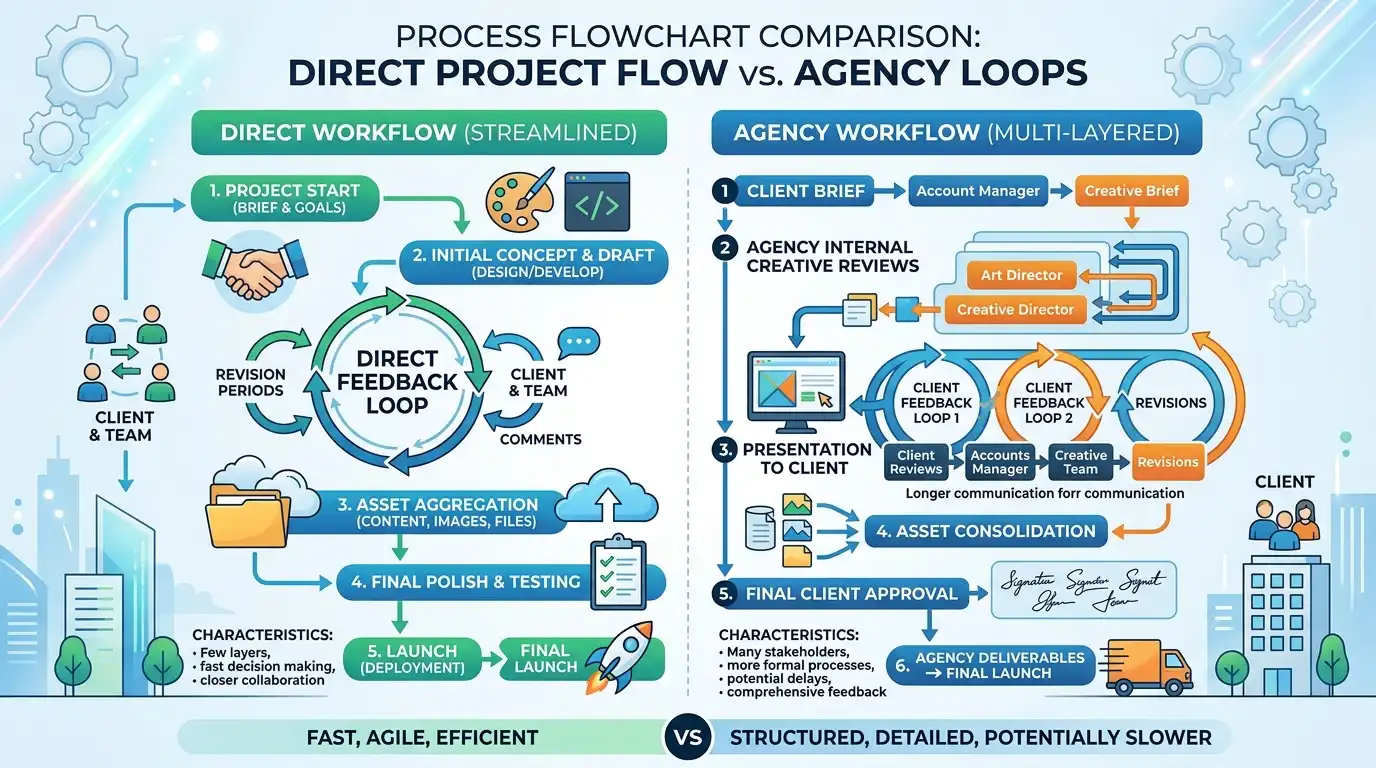
The biggest gap in pricing is driven by business structure. Agencies must cover salaries, lease offices, and charge client retention fees, which inflates the final bill without guaranteeing a better product.
| Factor | DIY Builder | Freelancer Package | Traditional Agency |
|---|---|---|---|
| Typical Cost | $0 to $300 | $369 to $1,649 | $3,000 to $15,000+ |
| Typical Timeline | Weeks of your own time | 8 days to 4 weeks | 6 to 12 weeks+ |
| Customization | Low (Template boundaries) | High (Custom layouts) | High (Agency workflow) |
| SEO Setup | Self-configured | Included Standard | Expensive upsell |
| Communication | None | Direct with designer | Via Account Managers |
| Ownership | Locked to platform | 100% Client-Owned | Sometimes restricted |
| Best For | Hobbies with no budget | Local business growth | Enterprises with teams |
Affordable Small Business Website Packages
Affordable website design does not require you to compromise on quality, but it does mean choosing a set scope. By narrowing down pages to what is essential, you keep layout development fast and expenses low.
| Budget Tier | Typical Features | Best Fit | Limitations |
|---|---|---|---|
| Under $300 | Basic DIY setup, default templates | Hobbies, proof-of-concept projects | Generic visual look, zero SEO, no technical support |
| $300 to $800 | Hand-built pages, contact form, basic SEO | Local services (trades, clinics, studios) | No built-in CMS or blog, limited page counts |
| $800 to $3,000 | CMS integration, booking setup, e-commerce | Retail stores, clinics with bookings | Requires content inputs; not for custom web applications |
| Over $3,000 | Bespoke databases, custom marketing funnels | Large enterprise entities | Slow build timelines, substantial administrative overhead |
Website Maintenance Package Pricing for Small Businesses
A website package gets your site live. A maintenance package keeps it that way. Once a site is built on WordPress or any platform with plugins and a content management system, it needs ongoing security monitoring, backups, and updates, or it slowly becomes a liability instead of an asset. Maintenance package pricing for small businesses usually scales with how much hands-on support you actually need each month, not just the size of the site.
What actually happens if you skip maintenance
Skipping maintenance is the single most common mistake small business owners make after launch. A site that goes a year without updates is far more likely to get hacked, break after a plugin update, or quietly slow down until visitors start leaving before the page even loads. None of this tends to happen on day one. It builds up quietly over months until a plugin conflict takes the site down the week of a big promotion, or a security scanner flags malware that has been sitting unnoticed for weeks.
The real cost of skipping a maintenance plan rarely shows up as a single bill. It shows up as days of lost bookings while a hacked site gets cleaned up, or a developer charging an emergency call-out rate well above the monthly maintenance fee to fix something a routine update would have prevented. A modest monthly maintenance package is almost always cheaper than the one-off recovery cost it replaces, and it avoids the lost trust that comes with customers hitting a broken or flagged site.
Hidden costs to watch for in maintenance plans
A low monthly number can hide a higher real cost. Before signing up for any maintenance plan, small business or otherwise, confirm what happens outside the standard scope.
- Emergency fixes: Some providers charge a separate call-out rate for urgent issues even while you are on a paid plan. Ask whether emergency response is included or billed extra.
- Surge or seasonal pricing: A handful of providers raise rates during high-traffic periods like holiday sales. Get this in writing if your business has a seasonal peak.
- Contract lock-in: Long minimum terms with cancellation fees turn a flexible monthly cost into a fixed annual commitment. The Content Management plan below has no long-term lock-in for this reason.
- Scope creep on "minor" updates: What counts as a minor update versus a billable project can vary a lot between providers. Get a clear definition before you need one.
What maintenance does not cover
A maintenance plan keeps an existing site secure, backed up, and lightly updated. It is not a substitute for a redesign, a full rewrite of your content, or a new set of pages and features. If your business has outgrown the site itself rather than just needing it kept running, that is a design package conversation, not a maintenance one. Most providers, including this one, are upfront about that line so you are not paying a monthly fee expecting project-level work to be included.
Security and backups: what is actually being protected
Security monitoring on a maintained site means checking for unauthorized file changes, watching for known vulnerabilities in the platform and any plugins it uses, and keeping core software patched against issues that get discovered after launch. Backups matter just as much. A daily automated backup means that if something does go wrong, whether from a bad update, a hack, or a simple mistake, the site can be restored to a recent working version rather than rebuilt from scratch. The combination of the two is what actually prevents a small problem from turning into days of downtime, far more than either one on its own.
What actually drives maintenance pricing
Maintenance pricing for small businesses scales with a handful of concrete factors rather than a flat per-site fee. A simple brochure site with five static pages needs far less attention than an e-commerce store processing orders, syncing inventory, and handling payment gateway updates. A site with a blog or CMS that gets updated weekly needs more hands-on support than one that almost never changes. Traffic volume matters too, since a higher-traffic site needs closer monitoring for performance and uptime. This is why a single flat maintenance price across every type of website is usually a sign the plan has not been thought through carefully.
DIY maintenance versus paying for it
Handling updates yourself is possible if you are comfortable logging into a CMS dashboard, applying updates carefully, and checking the site afterward to confirm nothing broke. The real cost is time, an hour or two most months that is not always predictable, plus the risk of an update going wrong with nobody available to fix it quickly. For an owner whose time is better spent running the business, paying a fixed monthly fee for someone else to own that task is usually the better trade, even before accounting for the security and backup work most owners skip entirely when doing it themselves.
Content Management
Need regular updates to your website? We will handle content changes, image updates, and minor tweaks so you can focus on your business.
What's Included
Cancel anytime. No long-term commitment required.
Require Content Updates?
Let me manage the security, hosting, and content edits so you can run your business. Add Content Management maintenance to any package.
How to Choose the Right Website Package
Most owners overthink the design and underthink the scope. Work through these questions before comparing prices, and the right tier usually becomes obvious.
- How many pages do you actually need? A service business with one location rarely needs more than five pages. A business with more content, more products, or more locations needs more, which is the main driver between the Standard and Premium tiers.
- Do you need to publish content regularly? If you plan to run a blog, post case studies, or update offers often, you need a CMS, which is included from the Premium tier.
- Will you sell products directly on the site? E-commerce needs change the build complexity significantly, so confirm product count and payment provider needs upfront.
- Who is maintaining the site after launch? If the answer is nobody, budget for at least the Content Management maintenance plan, not just the one-time design package.
- What is included versus what is an upsell? Ask for the full feature list in writing before paying anything, including who owns the domain, hosting, and final files.
For most small businesses serving local or regional customers, the Premium tier is the package that pays for itself fastest. It is design-first, includes the content tools you will need within the first year, and avoids the common mistake of outgrowing a Standard site within a few months.
Red flags to watch for before you sign
- A quote with no fixed total price, only an hourly rate with no estimate of total hours
- No clear answer about who owns the domain, hosting account, and source files after launch
- A renewal or "support" fee that only gets mentioned after you have already paid the first invoice
- A written feature list that is vague enough to mean almost anything, such as "SEO included" with no detail
- Pressure to sign before you have seen examples of the provider's actual past work
What to clarify in the first conversation
Before agreeing to any package, walk through a short list of scoping questions with whoever is building the site. Confirm exactly how many pages are included and what counts as an additional page if you go over. Ask how content readiness affects the timeline, since a provider who quotes 8 to 12 days assumes you can supply photos and copy promptly, not weeks later. Ask who is responsible for writing the copy itself, since some packages include this and others expect you to provide finished text. Finally, confirm what happens if you are not satisfied with the first draft, and how many further rounds of changes are included before extra revisions are billed separately.
Custom design versus template: how to decide
A template approach, used at the Standard tier, gets a professional layout live faster and at a lower cost by working within a proven structure rather than designing one from scratch. A custom, design-first approach, used at the Premium tier, takes more time but builds the layout, colors, and structure specifically around your business and your customers rather than fitting your content into someone else's structure. Neither is automatically the right answer. A new business validating an idea often does not need a custom build yet. An established business that depends on its site to convert visitors into paying customers usually gets a faster return from the custom approach, since small improvements in layout and clarity translate directly into more enquiries.
Frequently Asked Questions
Find answers to common questions about our website packages, pricing inclusions, ownership parameters, and post-launch support.
What is included in a small business website package?+
A standard small business website package includes a custom-built website with a set number of pages (typically 5 to 10), mobile responsive design, a secure contact form with email notifications, and basic on-page SEO setup. Reputable packages also include integration with Google Analytics, social media links, and a messaging system like WhatsApp. Furthermore, the provider should handle the initial domain and hosting setup and hand over complete ownership of all accounts upon completion. What separates a quality package from a cheap template dump is the focus on custom copywriting structure, layout planning, and performance optimization. Before purchasing a website package for small business owners, always request a detailed, written list of exactly what features are included to avoid hidden fees during the design process.
How much should a small business spend on a website?+
A small business should typically spend between $500 and $3,000 on a website package, depending on their page count and feature requirements. A simple service business, such as a tradesperson or local consultant, can usually get an excellent, high-performing site for around $369 with a Standard website package. Growing businesses that require e-commerce, booking calendars, multi-language support, or a content management system (CMS) to publish blogs should budget between $1,500 and $3,000. Going below $300 often means relying on DIY website builders that look generic and offer poor SEO, while paying agencies over $5,000 usually covers corporate overhead rather than a better design. A freelancer offers the best balance of affordable website packages and premium, hands-on design.
Can I upgrade my website package later?+
Yes, you can absolutely start with a Standard website package and upgrade to a Premium package later as your business grows. Because these small business website packages are built using clean, modular code rather than restrictive proprietary software, adding new pages, e-commerce stores, or booking systems is straightforward. An upgrade path allows you to launch your website quickly and begin generating leads without a large upfront investment. When you are ready to expand, a developer can integrate a blog CMS or configure product checkouts without needing to redesign the site from scratch. However, it is crucial to confirm with your website builder upfront that your site is built on an open platform that supports future expansion rather than a locked system.
Do I own the website completely after launch?+
Yes, you will own the website, domain name, hosting account, and all source code completely upon final delivery. Unlike many agency agreements or cheap proprietary website builders that lock you into monthly rental fees, all login credentials and account access are handed over directly to you. This means you are never held hostage by a single developer or platform and can make updates, change hosting providers, or hire another designer at any time. It is a critical red flag if a designer registers your domain name under their own agency account or refuses to grant you full administrative access. Ensure your contract explicitly states that you retain 100% legal ownership of your digital assets once the project is paid in full.
Can I move my hosting to another provider later?+
Yes, since you own 100% of the website files and the domain, you can move your hosting to any provider of your choice at any time. Websites built on open technologies like Next.js, React, or standard HTML can be deployed to modern hosting platforms such as Vercel, Netlify, or standard VPS servers. You are never restricted to a closed platform that prevents you from exporting your code. If your website experiences traffic growth or you find a hosting provider with better performance and lower monthly rates, the migration process is simple. Having the freedom to move hosting means you control your monthly expenses and are never stuck with a slow, unreliable server that hurts your user experience.
Is SEO included in these website packages?+
Yes, basic on-page SEO is included as standard in every small business website package. This includes writing clean semantic HTML code, optimizing all page titles and meta descriptions for search engines, and structuring your content with proper heading tags. We also optimize image sizes for fast load speeds, submit your XML sitemap to Google Search Console, and connect Google Analytics so you can track search traffic. While some agencies charge an extra $200 to $500 for basic search optimization, we believe a website is not truly finished unless search engines can read and index it. For advanced needs, the Premium package offers deeper keyword targeting and technical performance optimizations to help you rank higher for competitive terms.
How long does it take to launch a website package?+
A Standard website package typically takes between 8 and 12 business days to build and launch, while a Premium package with custom features like a CMS or booking system takes about 4 weeks. The timeline is highly dependent on how quickly you can supply the required photos, logos, and written text for your pages. Once all assets are received, the design work begins immediately, with scheduled revision rounds to ensure you are happy with the layout. Working with an independent designer means the process is streamlined and avoids the weeks of administrative delays, internal meetings, and project manager handoffs common with traditional design agencies, allowing you to get online and start attracting customers much faster.
Can you redesign my existing small business website?+
Yes, we can redesign and modernize your existing website using our small business website design packages. A redesign project involves analyzing your current layout, identifying what is not working, and rebuilding the site with a modern design, faster load times, and better mobile responsiveness. Crucially, we pay close attention to your search engine rankings during the redesign process. We set up 301 redirects for your old URLs, map your existing keywords, and ensure that search engines do not lose track of your business. This prevents the temporary drop in Google rankings that often happens when redesigns are handled by inexperienced builders. A redesign is an excellent way to turn an outdated page into a high-converting sales tool.
Can I add e-commerce or booking features later?+
Yes, you can add e-commerce functionality, product catalogs, or booking and appointment systems to your site at any point in the future. Because our code is built to be modular and scalable, you do not need to purchase the Premium package on day one if you only need a basic informational site. When your business is ready to accept online payments or schedule appointments, we can expand your existing layout by connecting payment gateways like Stripe or scheduling platforms like Calendly. This modular approach allows you to manage your budget effectively, keeping initial costs low while retaining the full technical flexibility to grow your website package in parallel with your business revenue.
Do I need a monthly website maintenance package?+
If your website is built on a dynamic system like WordPress, monthly maintenance is essential to keep plugins updated, back up database files, and monitor security vulnerabilities. Unmaintained websites are primary targets for hackers and often experience plugin conflicts that can take the site offline. For static sites or custom headless builds, maintenance is less critical but still recommended for handling content changes, updating images, and monitoring performance. Our Content Management package at $129 per month handles all minor updates, security monitoring, and daily backups so you can focus entirely on running your business. It is a cost-effective alternative to hiring a developer at an emergency hourly rate when something breaks.
Should I hire a freelancer or an agency for my website?+
For most small businesses, hiring a freelancer or independent designer is the most efficient and cost-effective choice. Agencies charge higher fees because they must cover salaries for account managers, sales representatives, and office rent, which does not translate to a higher quality website. A freelancer gives you direct communication with the person actually building your site, leading to faster revisions and a more personalized design. The timeline is also much shorter, as you do not have to wait for agency approval queues. If your project requires custom, custom software integrations with multiple stakeholders, an agency might be necessary. However, for a standard brochure, CMS, or e-commerce website, a freelance package offers agency-level quality for a fraction of the cost.
Are cheap website packages under $300 good quality?+
Website packages priced under $300 are rarely high quality and often cost more in the long run due to hidden fees and limitations. Most cheap options are basic template dumps where a generic layout is installed without any customization, copy editing, or speed optimization. They typically lack mobile responsive design, have broken or untested contact forms, and ignore basic on-page SEO entirely. Furthermore, cheap providers often lock your domain and hosting under their accounts, forcing you to pay high monthly fees to keep the site online. A professional, affordable website package should include full ownership, clean code, and basic search engine setup, which is why a realistic investment starts around $369 for a quality build.
What is the difference between design packages and maintenance packages?+
A website design package is a one-time project fee that covers the creation, development, and launch of your website. It includes the design layout, page structuring, SEO setup, and analytics integration. In contrast, a website maintenance package is an ongoing, monthly subscription that covers the technical support, security patches, file backups, and minor content updates needed after the website is live. You only pay for a design package once, but a maintenance package keeps the site secure and functional over time. While maintenance is optional, it provides peace of mind that a professional is monitoring your site's performance and is available to fix any bugs or publish content updates quickly.
Have a Question Not Answered Here?
Send me a message with details about your project or required features. I will respond within 24 hours with a direct, honest answer.
Want to see the reasoning behind these prices in more detail? Check examples of recent work on the creative work section, read more about our background on the about page, or reach out directly through the contact page.
Ready to get your small business online?
Pick a package above or talk through your project first. Every build starts with clear pricing and ends with you owning every account, with no hidden renewal fees and no surprise invoice once the project is done.