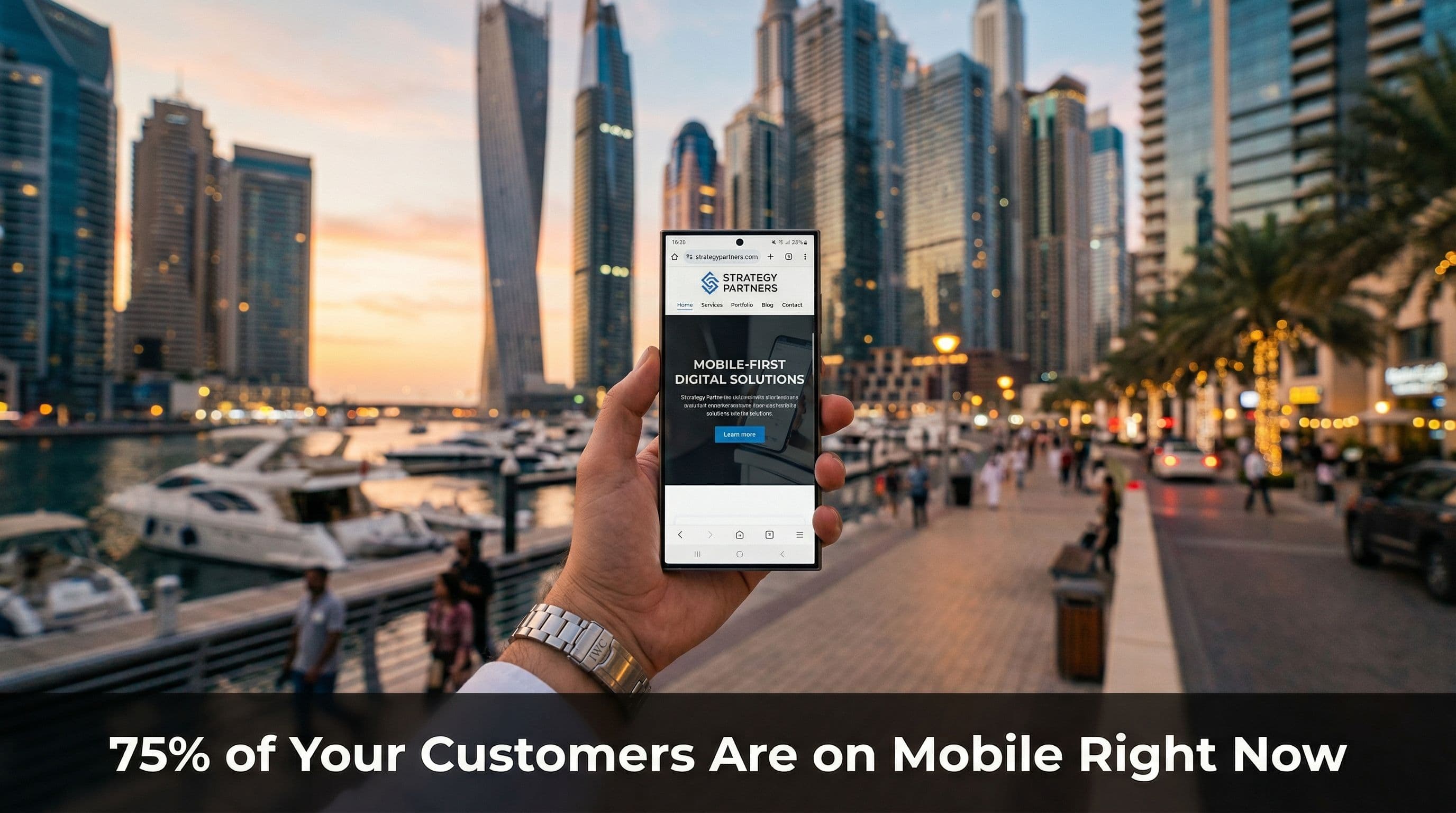
Mobile Website Design for Dubai, Qatar, and Saudi Arabia
Mobile website design for Gulf businesses is not the same as mobile design anywhere else. Over 75% of web traffic comes from mobile devices
Mobile website design for Gulf businesses is not the same as mobile design anywhere else. In the UAE, Qatar, Saudi Arabia, Kuwait, and Bahrain, over 75% of web traffic comes from mobile devices.
Here is something that surprises most business owners when they first hear it: your website does not need to look good on a desktop. It needs to look good on the phone of a 34-year-old professional in Riyadh who has 8 seconds of patience and four other tabs open.
That sounds harsh. But that is the reality of the Gulf market in 2026. The people you are trying to reach — whether you are running a clinic in Doha, a consultancy in Abu Dhabi, or a retail shop in Kuwait City — are almost entirely mobile users. And they are not forgiving about bad experiences.
Why the Gulf Is a Different Mobile Market Entirely
A developer who made websites in London or New York, then switched to clients in the Gulf, will say the same thing: old ideas don't work here. In Dubai, everyone has super-fast 5G - it's normal, not special. In Qatar, over 90% of people own smartphones. In Saudi Arabia, folks spend more than 3 hours a day on their phones. They use that time to search for services, read reviews, and check out businesses before calling.
What this means for you: your users aren't on slow internet, waiting for pages to load. They have fast connections and big expectations. If your site takes 4 seconds to load, it feels broken to them - not just slow. Totally broken.
"Mobile-First" Is Not Just Making the Desktop Version Smaller
This is where a lot of cheap website builders and inexperienced designers go wrong. They build a desktop site, then shrink it down and call it mobile-friendly. The result is a site that technically works on a phone but feels clunky — text too small, buttons too close together, images that take forever to load.
Real mobile-first design starts from the phone screen. Layout, font size, image weight, button placement — is made for a thumb, not a mouse. The desktop version is built after. This approach is why some websites feel beautiful on a phone and others feel like you are navigating a PDF.
One thing that rarely gets mentioned: Gulf users have large phone screens. The average screen size in the UAE and Saudi Arabia is noticeably larger than European markets because people prefer larger display phones. Your mobile layout needs generous spacing, readable font sizes (minimum 16px body text), and tap targets that do not require precision clicking.
The WhatsApp Button Is Your Most Valuable Piece of Mobile Design
WhatsApp button
Forget contact forms for a moment. In Qatar, Kuwait, Bahrain, and across the UAE, WhatsApp is how people communicate with businesses. Not email. Not a web form that takes eight fields to fill in. A single tap on WhatsApp.
A sticky WhatsApp button — one that stays fixed at the bottom of the screen as the user scrolls — is consistently the highest-converting element. The button should be visible without scrolling, large enough to tap easily, and should open a pre-written message so the user does not have to figure out what to type.
Something like: "Hi, I found your website and I would like to know more about your services." That's it. Remove every possible barrier between the visitor and the first message.
Arabic on Mobile Is a Completely Different Design Problem
Arabic reads right to left. That sounds simple, but it means your entire layout flips — navigation moves to the right, content flows from right to left, icons and arrows reverse direction. A site that just has Arabic text injected into an English layout will look wrong to Arabic readers immediately. They will notice it in under two seconds, and it signals that you did not really build this for them.
For businesses in Saudi Arabia and Bahrain especially, where the customer base is predominantly Arabic-speaking, getting RTL (right-to-left) design right is not optional. It is the difference between a website that feels local and one that feels like a foreign company that added an Arabic button as an afterthought.
Images Are Usually the Culprit
If your mobile site is slow, it is almost always the images. A single unoptimized photo from an iPhone camera can be 4 to 6MB. Three of those on a homepage and your site takes 12 seconds to load — even on a decent connection. All images on a mobile-first site should be converted to WebP format, compressed, and lazy loaded (meaning they only load when the user scrolls to them).
This is a technical step that most DIY website builders skip entirely. It is also one of the biggest differences between a site that scores 90+ on Google PageSpeed and one that scores 45.
So What Does a Proper Mobile-First Website Cost in the Gulf?
Less than most agencies in Dubai or Riyadh will quote you. A properly built mobile-first website — with WhatsApp integration, optimized images, fast loading, and a responsive design — starts at $449 as a one-time payment. No monthly fees. Delivered less than in 14 days.
See what is included: sheikhhassaan.com/launch-your-website
Frequently Asked Questions
What is mobile-first web design?
Mobile-first design means building a website for phone screens before desktop screens. This approach results in faster sites that perform better on Google and convert more visitors into enquiries.
Why is mobile design especially important for businesses in Dubai, Qatar, and Saudi Arabia?
Over 75% of web traffic in the UAE, Qatar, Saudi Arabia, Kuwait, and Bahrain comes from mobile devices. A site that works poorly on mobile loses the majority of its visitors before they ever read your services.
Should a website have a WhatsApp button?
Yes — it is the single most important conversion element on a Gulf business website. WhatsApp is the primary communication channel across the UAE, Qatar, Saudi Arabia, Kuwait, and Bahrain.
Does a mobile website need to support Arabic?
For businesses targeting local Gulf customers in Saudi Arabia, Bahrain, Kuwait, and the UAE — yes. A properly implemented Arabic version signals to local customers that the site was genuinely built for them.
How do I make my website load faster on mobile?
The most impactful steps are: converting all images to WebP format, compressing images before upload, implementing lazy loading so images only load when visible, and using a fast hosting provider. These steps alone typically improve Google PageSpeed scores by 30 to 50 points and reduce load times from 6+ seconds to under 2 seconds.