
Retro vintage poster of a Dubai ecommerce business owner
Best Ecommerce Website Design in Dubai 2026
Stop losing sales to slow checkouts. Learn the best ecommerce website design in Dubai for 2026.
A guide for Dubai business owners on building high-conversion ecommerce stores that work for the UAE market and convert international traffic in 2026.
By Sheikh Hassaan, digital architect for small businesses
Quick Answer
The best ecommerce website design in Dubai for 2026 focuses on mobile-first performance, fast load times, and local integrations like Tabby, Tamara, and Telr. To win the UAE market, businesses should choose Shopify for ease of use or WooCommerce for long-term flexibility and SEO control. A properly built ecommerce store at a fixed $449 price gives Dubai small businesses a revenue-generating asset without the agency overhead.
Why pretty ecommerce sites fail in Dubai
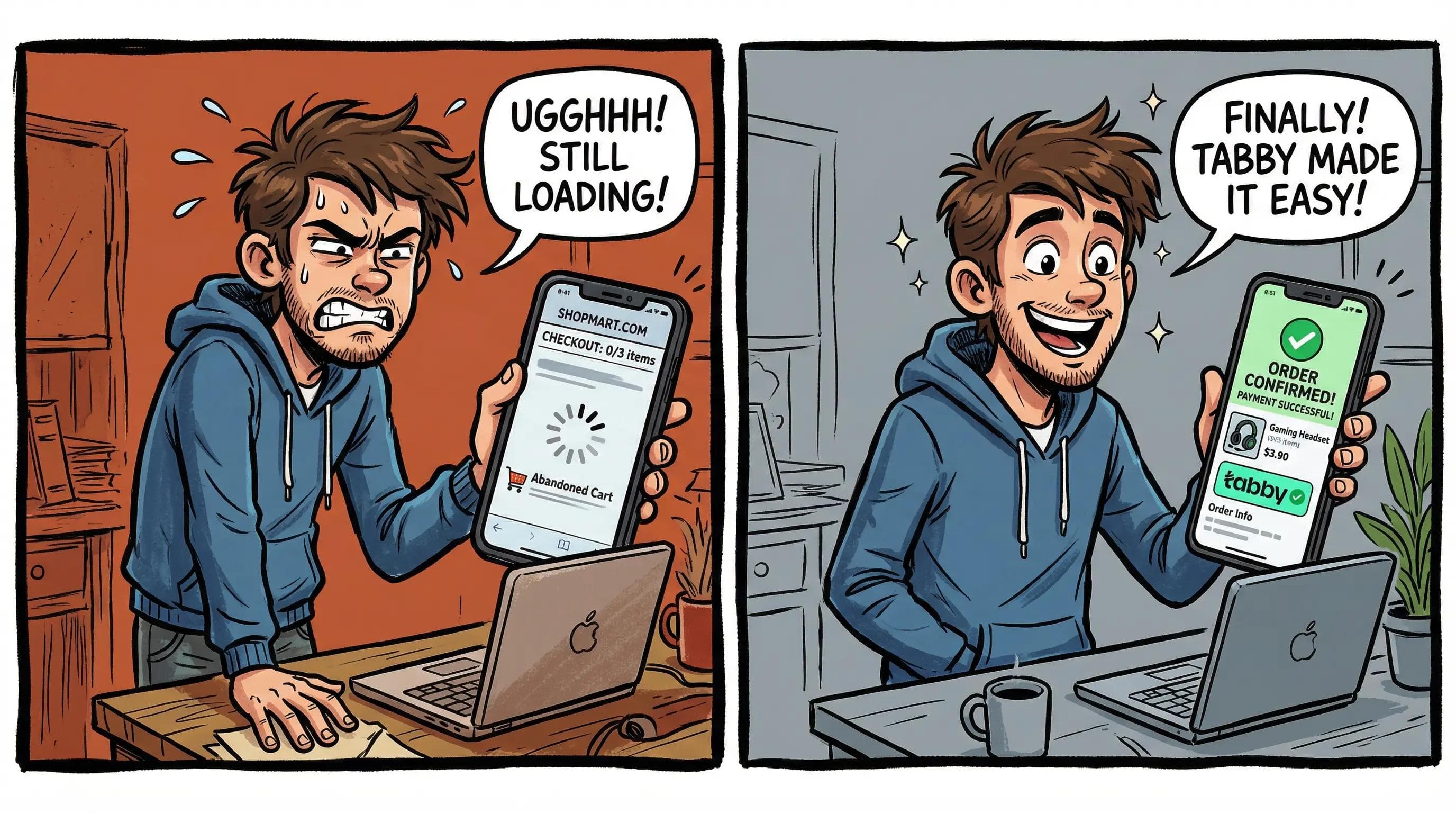
Comic strip showing Dubai ecommerce customer abandoning a slow loading store versus completing a purchase on a fast UAE-optimised ecommerce site
In 2026, a beautiful ecommerce website is no longer enough to win in Dubai. Potential customers browsing on mobile expect pages to load instantly. If your store takes more than 1.5 seconds to load on a mobile connection, most visitors will leave before they see a single product. This speed gap is one of the main reasons new ecommerce ventures in the UAE struggle to convert traffic into sales.
Beyond speed, there is the trust gap. Dubai consumers are sensitive to payment security and delivery reliability. If your checkout does not include local payment options like Tabby, Tamara, or established UAE gateways like Telr and Checkout.com, visitors will abandon their cart at the payment step. You do not just need a web designer. You need someone who understands the technical and commercial realities of selling online in the GCC market.
Shopify vs WooCommerce vs Custom: Which is right for your UAE business?

Shopify versus WooCommerce
Choosing the right platform is one of the most important decisions for your ecommerce project. In Dubai, the three main options each have real trade-offs. Here is a clear comparison to help you decide before you spend anything.
| Feature | Shopify (SaaS | WooCommerce (Self-Hosted) | Custom or Headless |
|---|---|---|---|
| Ease of Use | Very High | Moderate | Technical |
| Customization | Limited by Platform | Unlimited | Infinite |
| Maintenance | Handled by Shopify | You are responsible | Technical Team Required |
| Local SEO Power | Good | Excellent: Total Control | Best but Expensive |
| UAE Integrations | Native Apps Available | Deep API Flexibility | Custom Integration |
| Monthly Cost | $39+ plus transaction fees | $0 plus hosting and plugins | Monthly Cost $39+ plus transaction fees $0 plus hosting and plugins $500+ high overhead |
| Best For | Fast Launch, Low Tech | Long-term SEO and Growth | Enterprise or Scale |
For most Dubai small businesses, WooCommerce offers superior SEO control and lower long-term costs. Shopify works well for businesses that want a completely managed technical experience with no server responsibility. Both can be high-performance sales engines when built correctly from the start.
5 Essential local integrations for Dubai ecommerce in 2026
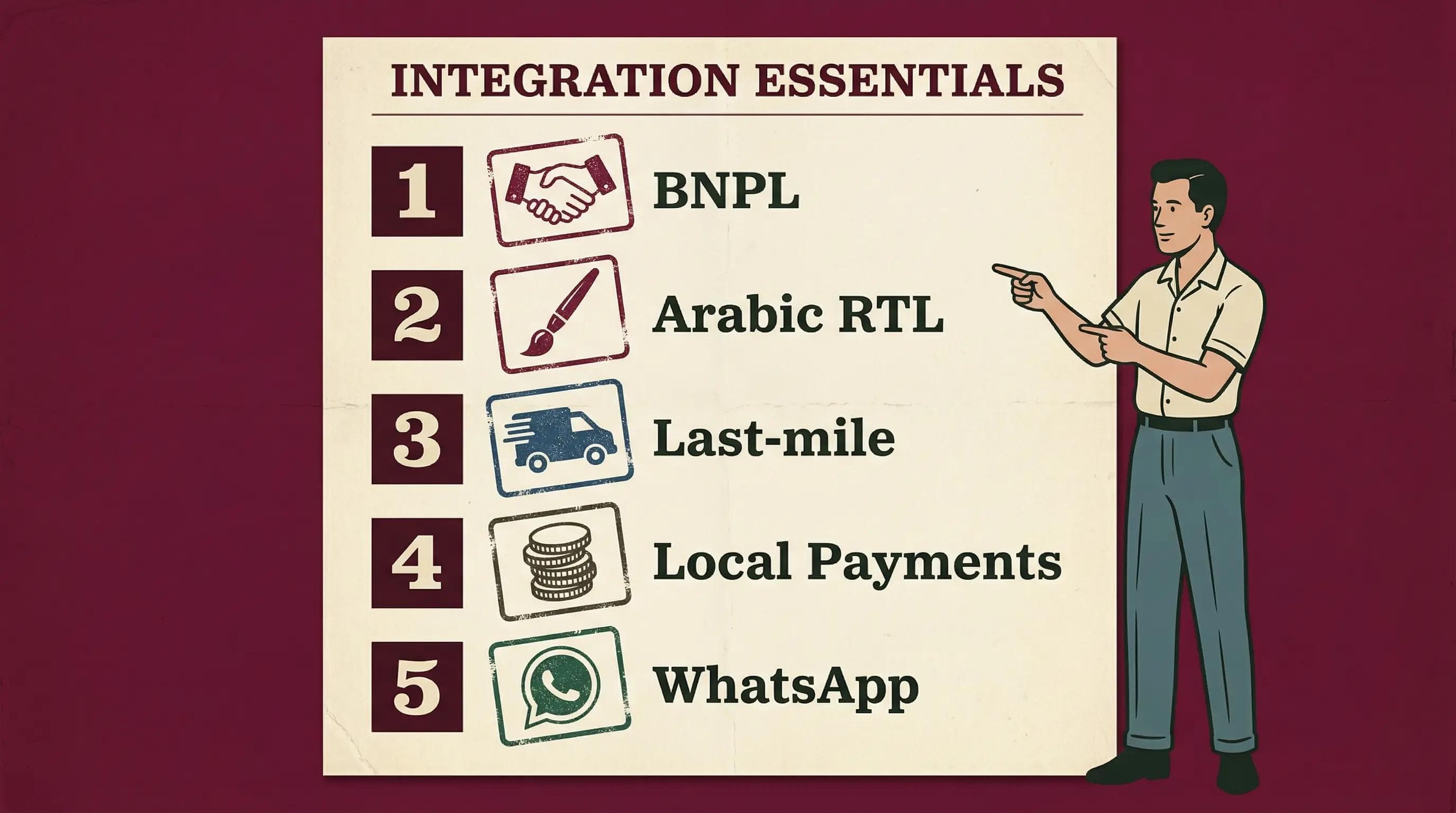
Five essential local integrations for Dubai ecommerce
To rank well in Dubai and convert both local and international traffic, your ecommerce store needs these five local signals. If your current developer has not mentioned them, the store is missing important elements for the UAE market.
1.BNPL Integration: Tabby and Tamara are widely used in the UAE. Offering buy now pay later at checkout can increase average order value significantly for Dubai shoppers who prefer to split payments.
2.Arabic Language RTL Support: Even if your primary audience is English-speaking, having a quality Arabic version of your store sends a strong local signal to Google UAE and opens your store to a wider audience.
3.Last-Mile Delivery Sync: Integrating with local carriers like Aramex or Shipa gives customers real-time tracking. Reliable delivery visibility is one of the top factors driving repeat purchases in Dubai.
4.Local Payment Gateways: While Stripe works globally, using local gateways like Telr or Network International often provides better support and lower fees for UAE-registered businesses.
5.WhatsApp for Sales and Support: Dubai shoppers prefer to ask questions and confirm orders through WhatsApp. Automated WhatsApp flows for order confirmations, shipping updates, and direct enquiries reduce abandoned carts and build trust.
WooCommerce vs Shopify
The WooCommerce vs Shopify debate comes up in almost every ecommerce conversation I have with Dubai business owners. Both platforms work. The difference is in who they work best for.
Shopify is a fully hosted solution. You pay a monthly fee and Shopify handles the servers, security updates, and platform maintenance. For a business owner who wants to focus entirely on selling and not on managing a website, Shopify removes most of the technical friction. The trade-off is that you pay transaction fees on every sale unless you use Shopify Payments, which is not available in the UAE. This makes the true monthly cost higher than the listed price for most Dubai businesses.
WooCommerce runs on WordPress, which you host yourself. This gives you complete control over your data, your SEO structure, and your costs. There are no transaction fees beyond your payment gateway. The trade-off is that you are responsible for updates, backups, and security. When these are handled correctly by a developer who knows what they are doing, WooCommerce consistently outperforms Shopify for long-term organic search rankings in competitive markets like Dubai.
For most Dubai small businesses selling physical or digital products, WooCommerce at $449 gives you more control, lower ongoing costs, and stronger SEO potential than Shopify at $39 per month plus fees.
How I build ecommerce stores for $449

Dubai ecommerce business owner in premium studio workspace
Most ecommerce designers in Dubai charge between $5,000 and $15,000 for a standard store. A large part of that cost covers agency overhead: project managers, design iterations, and account calls. The technical work that actually drives sales often gets less attention than the visual presentation.
The approach I take is different. Whether I am using Shopify or a WooCommerce build, the goal is to eliminate unnecessary weight from the store and focus on the elements that convert visitors into buyers. This means fast load speed on UAE mobile networks, local payment options set up correctly, WhatsApp integration at every key touchpoint, and a checkout flow that removes friction rather than adding it.
The $449 package is a fixed-price foundation designed for Dubai small businesses and service providers who want to sell online without the agency price tag. You get full ownership of the store from day one, no monthly platform markup beyond standard hosting, and a build that is ready to generate sales from launch.
Launch Your Dubai Ecommerce Store
About the Author
Sheikh Hassaan, Digital Architect for Small Businesses
I help Dubai businesses launch fast, secure, conversion-focused websites and online stores without the agency price tag.
Related Articles
- Custom Website or WordPress for Your Dubai Business in 2026?
- Best SEO Agency in Dubai: Choose ROI-Driven Services in 2026
- WordPress Security for Dubai Small Businesses 2026 Guide
Frequently Asked Questions
How much does an ecommerce website cost in Dubai?
Professional ecommerce agencies in Dubai typically charge between $5,000 and $20,000 for a standard store. Freelancers may charge less but often lack experience with local UAE payment integrations and shipping providers. A fixed-price package at $449 delivers an ecommerce foundation with all essential local integrations included from the start.
Which is better for Dubai: Shopify or WooCommerce?
Shopify is better for businesses that want a simple all-in-one solution without server management. WooCommerce is better for businesses that want full control over their SEO, data, and long-term costs. Both work well in the UAE market when built and configured correctly. The right choice depends on your technical comfort level and growth plans.
How long does it take to build an ecommerce store in Dubai?
A properly built ecommerce store for a Dubai small business typically takes 7 to 14 days from the first conversation to going live. The timeline depends on the number of products, the integrations required, and how quickly the client can provide content and product information.
Can you integrate Tabby and Tamara into my existing store?
Yes. If you have an existing Shopify or WooCommerce store that is not converting well, adding local buy now pay later options like Tabby and Tamara to your checkout is one of the highest-impact improvements you can make for the UAE market. It can be done without a full rebuild in most cases.
Do you handle ecommerce SEO in Dubai?
Yes. Every store I build includes basic SEO setup from day one: proper page titles and descriptions, schema markup for products, local UAE signals, and Google Search Console connection. This gives the store the best possible foundation for organic search visibility from the moment it goes live.